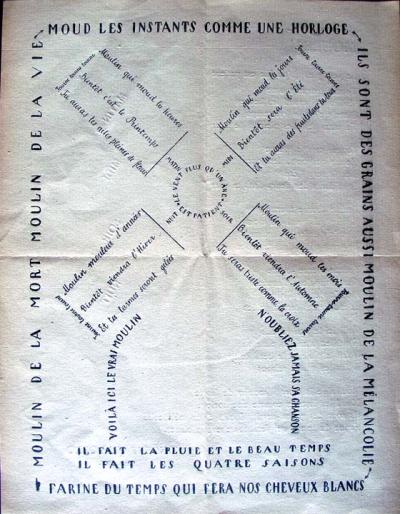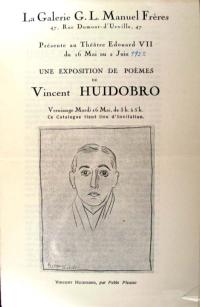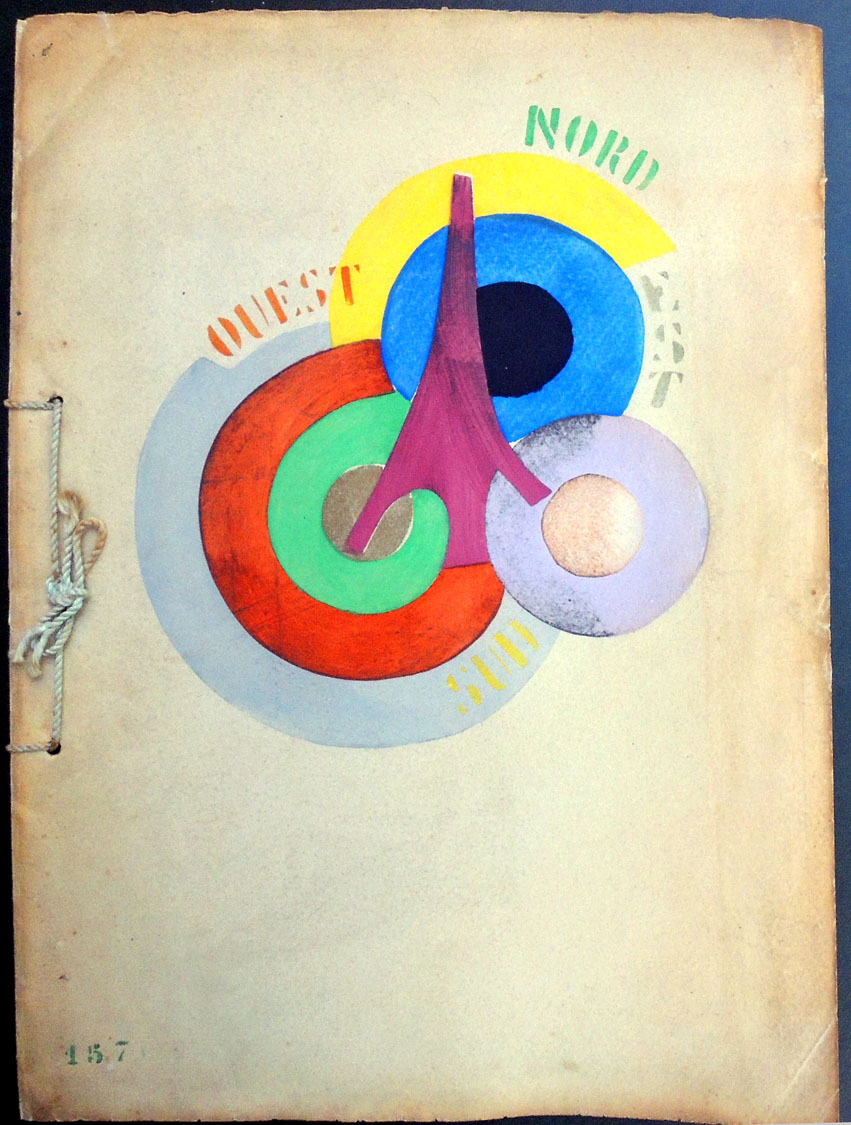
Vicente Huidobro (1893-1948) and Robert Delaunay (1885-1941), Tour Eiffel. Poème par Vincente Huidobro; peintures par Robert Delaunay (Madrid: privately printed, 1918).
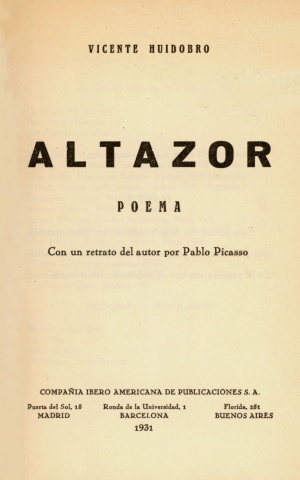
The first modern poet of the Spanish language — in many ways its Apollinaire — Vicente Huidobro is generally considered to be one of the four greatest Spanish American poets of [the last] century. Yet unlike his peers — César Vallejo, Pablo Neruda, and Octavio Paz — Huidobro is still little-known in the English-speaking world.
Altazor, a book-length poem first published in 1931, is Huidobro’s masterpiece and one of the wildest poems of any language. The century’s great paean to flight, the poem sends its hero (Altazor, the antipoet) hurtling through Einsteinian space at light-speed, as all places and times collapse into one.” (from the back cover)
Publisher Compañia Ibero Americana de Publicaciones, Madrid/Barcelona/Buenos Aires, 1931
111 pages
Bilingual Spanish/English edition
Translated by Eliot Weinberger
Publisher Graywolf Press, Saint Paul, Minnesota, 1988
A Palabra Sur Book
ISBN 1555971067
167 pages
via filboid
portrait by Picasso
MINUIT
Les heures glissent
Comme des gouttes d’eau sur une vitr Silence de Minuit
La peur se déroule dans l’air
Et le vent
se cache au fond du puits
OH
C’est une feuille
on pense que la terre va finir
Le temps
remue dans l’ombre
tout le monde dort
UN SOUPIR
Dans la maison quelqu’un vient de mourir
translated by the author from the original Spanish
(From Horizon Carré, Paris : Paul Birault, 1917.)
silence de minuit
Dans la maison quelqu’un vient de mourir
(From Horizon Carré, Paris : Paul Birault, 1917.)

During the interwar period, Pablo Neruda’s great rival in Chile’s “literary battle” was Vicente Huidobro, whose figure has become the epitome of the poetic vanguard. Nicanor Parra gave a personal homage to Huidobro and his oeuvre in a speech marking the centenary of Huidobro’s birth in 1993. In this lab work, carried out around the same time, Parra ironizes the legend maintaining that Huidobro, upon his return from Europe — where he traveled during World War II as a war correspondent and accompanied the allied forces upon their arrival into Berlin — took with him, as loot, one of Adolf Hitler’s telephones.
LXXXII
anyway
He was the one who set the first stone
As well as the antepenultimate
Of that building called New Chilean Poetry
When Neftalí Reyes
Had not yet changed his name
Those were the days of the First World War
Those were the nights of the Second World War
He came down from his ivory tower
He said nope
To all forms of dimwitarianism
Let Hitler’s telephone say it
Nicanor Parra, “Also Sprach Altazor” (1993) (translated by Magdalena Edwards)

|

Acacias
Strolling many years ago
Down a street taken over by acacias in bloom
I found out from a friend who knows everything
That you had just gotten married.
I told him that I really
Had nothing to do with it.
I never loved you
— You know that better than I do —
Yet each time the acacias bloom
— Can you believe it? —
I get the very same feeling I had
When they hit me point-blank
With the heartbreaking news
That you had married someone else.
— translated by David Unger
“Estados Unidos: el país donde
la libertad es una estatua.”
–Nicanor Parra, Artefactos
“United States: the country where
liberty is a statue”.
Translated by Anna Deeny

Translated by Mike Topp
Santa Fe Trail I go separately The sweet knees of oxen have pressed a path for me ghosts with ingots have burned their bare hands it is th...