Showing posts with label contemporary2. Show all posts

Tuesday, February 22, 2022

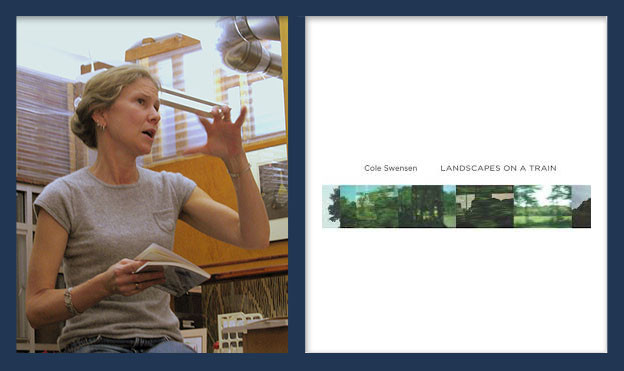
Cole Swensen

Cole Swensen


3 - Where does a poem usually begin for you? Are you an author of short pieces that end up combining into a larger project, or are you working on a "book" from the very beginning?


I tend to work on a book from the very beginning. In the last few things I’ve written, the book is the basic unit, so while my books are composed of discrete poems, they are conceived as larger units. 


Lately books have started for me through a nagging interest that I want to explore, and often that exploration amounts to lots of reading and light research, and often it has something to do with the visual arts—the visual arts linked with history. It’s a way, perhaps, of insisting upon poetry as language-as-art rather than language-as-information. I feel like I learned a lot the Language poets when I was in my early 20s, and particularly about the material potential of language on the one hand and the dangers (political and social) of the illusion of transparent and/or objective language on the other. That attention to surface has mixed in me with a love of the visual arts and has generated some of my works, though at times I regret poetry’s inability to achieve the same immediacy. 


 That regret is in part behind my interest in ekphrastic poetry, in reworking that genre so that it’s not so much a matter of standing across from a painting and attempting to replicate or translate its emotional impact, but of finding new ways to live with and in art, to make it increasingly present by having it infuse such a daily staple as language. 


I often begin with a specific work of art and a related idea. My most recent bookThe Glass Age, comes out of Pierre Bonnard’s paintings of windows and their paradoxical opacity (he used such vivid, dense, opaque colors), mixed with the idea that our age, beginning with the technological and scientific revolutions of the 19th century, is an increasingly fragile one, from the psychological brittleness caused by the loss of God to our potential to literally destroy the world.
The book I’d written before that, The Book of a Hundred Hands, began with a drawing manual by that name, and tries to see how much of a sheer concept the hand can become. And the last manuscript I finished, Ours, which is coming out in 2008, began in the 17th century formal French gardens of André Le Nôtre and addresses the idea of public versus private property.

Cole Swensen


Monday, February 21, 2022

Cole Swensen


André-Marie Ampère 1775–1836

electrically rowed Rousseau from a wide green meadow
                                                                                        into his brain
along with Buffon and Diderot
                                                 and the entire Enlightenment embroidered
in fractions, thus confusing
                                              poetry and mathematics. He stood back
and declared:
                        An umbrella could envelope
                                                                      a good part
of the village of Poleymieux en route to reviving the library
                                                                                             and why
did my wife die so young?
                                          Wrote out the psalms on his palm in the
electrodynamic molecules of his time
                                                           which he carried next to his heart
in a heart-shaped box
                                     obsessed
                                                   by Ørsted’s magnetized needle, leaping
full-grown and fully armed
                                           into the periodic table. Noble metals
isolated and at war
                               put each order in order
                                                                      and was the first to define
electric current as a circulation
                                                gazing out over the Mediterranean until it dies.


Sunday, February 20, 2022

Cole Swenson


Cole Swensen


Burnish

This is now uncommon. And therefore brittle sheers: 
To burnish is to 
raise the carapace, the doorknob, the letterbox, the concierge who 
gleaming in the sun, turns to sear. This gilded bone. A “we repeat it.” 
Did not reflect our faces. Or those of any we knew. This is a nameplate. Affixed 
to a doorway. No, to a door. Answer: there’s no one there. This is decor; a thin layer of gold that shines in tune. A leaf on which is added one to
one and one. 
It’s a name “scratched” “thereon” 
if I raise a finger 
and say I’m not at home, please; I may for once


Saturday, February 19, 2022

Dale Smith

  • ]


from Another Sky

Holy objects multiply. A child’s tooth 
amethyst. Ancient sources to peer through—
a watch, blue sage, faded polaroid. 
I sweat a lot when I look for words
violent and tangible, what we call real. 
Looking at what can be seen to absorb what can’t.
My nerves are frayed obligations. My hand 
grips membrane wilderness. Like a flag 
on a beachhead in winter. Like frozen 
edges of river slicing muddy banks. 
I’ve had enough of easy celebration.  
Sky like a giant’s belly. Cruel tension
shoulders uneven and in muscular knots. 
My memories are tangled up in things.

Dale Smith


New College of California in in the 1990s

First, a little history: any discussion of the Poetry and Poetics of the 1990s for me begins on the West Coast and, particularly, in San Francisco, where I had enrolled in the now defunct Poetics Program of the New College of California in 1994 (Hoa entered the MFA program in Poetics a year earlier). I was reading Ron Silliman and Robert Creeley at the time, feeling a sense of liberation, learning that even a young white kid from Texas could somehow acknowledge his experience in writing—or find ways to write outside the field of that experience—to encounter the intersectional realities enlivened by poetry. Silliman was probably the first author to really help me understand the

Some of the critical terms in this essay I take from Raymond Williams, particularly from his Politics and Letters: Interviews with New Left Review. He helps articulate the social and literary structures that enable communities of meaning, like those formed by small presses, to adhere in diverse cultural settings.

________________________________________________________________

_New College was founded in 1971 and emphasized social justice, Humanities, and psychology; it was located at 777 Valencia Street in the Mission in San Francisco, and ceased operations in 2008. Duncan McNaughton established the Poetics Program in 1980 with Louis Patler. Robert Duncan soon became a committed teacher in the

Program, fulfilling the demands of what he termed “a master teacher,” according to Lisa Jarnot (189). Aaron Shurin and David Levi-Straus attended the program in the eighties where Bay-Area poets like Diane di Prima, Michael Palmer, Joanne Kyger, and others taught occasionally throughout its existence. For insight into Duncan McNaughton’s work at New College and an appreciation of


The poets on the faculty would teach an author course or a context course, focusing on a different period each semester. I remember in spring 1995 taking a seminar with Tom Clark on Charles Olson and another with Lyn Hejinian on Gertrude Stein. David Meltzer in that same semester would teach the social history of modernism, with emphasis on West Coast social activism and the early twentieth-century labor movement. There were other semesters that focused on the Early Modern period, Romanticism, and the American nineteenth century. Of keen significance was Gloria Frym’s yearlong editorial course devoted to the publication of New College’s poetry journal, Prosodia. It was my first experience editing a magazine. I worked with co-editors Hoa Nguyen, Renee Gladman, Cliff Gassoway, and Leslie Davis to produce issue 5 (1995), with a cover by Iranian visual artist Shirin Neshat and new writing by Alice Notley, Rae Armantrout, Kevin Killian, John Yau, Rosmarie Waldrop, Leslie Scalapino, Anselm Berrigan, and Will Alexander. Gloria’s mentorship was crucial. She had studied with Creeley in New Mexico and brought a fine sense of the history and obligations of editing poetry to us at the time. It was important for her that we shape and give meaning to a community of writers and readers. In a quite practical sense, she also helped us contact poets for work, and we were grateful for the opportunity to learn the responsibilities of publication, ranging from solicitation and editing to print layout, production, distribution, and promotion of a literary journal.


page8image1098963328

sentence and how to separate the self from language and from the phenomenal reality of one’s perceptions. So, I came with this specific bent to the Program when I enrolled in Lyn Hejinian’s fall course offering in literary theory, “The Language of Paradise.” Other faculty included Gloria Frym, Adam Cornford, the late David Meltzer, and the volatile Tom Clark, who taught from his home in Berkeley, California. These poets brought specific histories, social and creative outlooks, and at times intense pedagogical conflicts to life in their courses. Unlike the creative writing programs that have grown up now all across North America, the Poetics Program was designed so that each semester poet-scholars led students in a specific period of study; we were asked to examine the complex social relationships that make poetry possible in specific geographic contexts and historical periods. Students encountered the legacy of “master teacher” Robert Duncan, whose contributions in the 1980s helped establish the program’s unique, pedagogical outlook, and we received accreditation thanks to the labor and advocacy of Duncan McNaughton, Louis Patler, and others who were involved in the formal establishment of the Poetics Program.2___________________________________________I love
this poet Pasolini and want to___um__Nov. 2 is the 50th anniversary
of his
___________________________________________I love

this poet Pasolini and want to___um__Nov. 2 is the 50th anniversary
of his unsolved murder___and I think about
___________that often___that no one has solved this man’s murder
___________T brought me a second copy of Divine Mimesis
___with Leslie’s ex libris stamp__pages are falling out of my copy
I put them next to each other___one Italian lesson in Chicago and several
Arabic__headache worse post-Stefano___“flirt
__________________with Zoraida__I say that because your speaking is angular
__seduce her!”__wait is he acknowledging that I’m the queer here or

__do Italians just want to seduce everyone with their musicality? unsolved murder___and I think about
___________that often___that no one has solved this man’s murder
___________T brought me a second copy of Divine Mimesis
___with Leslie’s ex libris stamp__pages are falling out of my copy
I put them next to each other___one Italian lesson in Chicago and several
Arabic__headache worse post-Stefano___“flirt
__________________with Zoraida__I say that because your speaking is angular
__seduce her!”__wait is he acknowledging that I’m the queer here or
__do Italians just want to seduce everyone with their musicality?


___________________________________________I love
this poet Pasolini and want to___um__Nov. 2 is the 50th anniversary
of his unsolved murder___and I think about
___________that often___that no one has solved this man’s murder
___________T brought me a second copy of Divine Mimesis
___wit


h Leslie’s ex libris stamp__pages are falling out of my copy
I put them next to each other___one Italian lesson in Chicago and several
Arabic__headache worse post-Stefano___“flirt
__________________with Zoraida__I say that because your speaking is angular
__seduce her!”__wait is he acknowledging that I’m the queer here or
__do Italians just want to seduce everyone with their musicality?

Dale Smith


Dale Smith, Anselm Berrigan, San Francisco


DECEMBER 10, 1999 

                    (for Ed Dorn)

Socratic bullets brain the narrow witted
Charmers and snake oil technicians who
Inherit a new order of human
Progress gripping a bull by the balls
The rambler takes new course among a band
Of star forms stitched in a Far West sky
Above the banks Embarrass to Hugh's Town
Brokers Dellianaires and other dis-
Possessed post-industry clerks eyes blurred
On pixeled screens' obital pages
Ashes spread high in rocky mountains
Fuck it, it feels like a hole in the sky
Yellow pages selling Amazons
Dot com confident triumphant win-win


Ilya Kaminsky


Ilya Kaminsky ihconstantcontactcomfs1421110705357409img209


Translation is the art of failure
-Umberto Eco

Poetry is what is lost in translation
-Frost

Poetry is what is found in translation
-Octavio Paz

Every great age of poetry is the great age of translation
-Pound

Bless thee, Bottom, bless thee. Thou art translated.
-Shakespeare

Friday, February 18, 2022

Sheila Murphy


Chance F/light 

Rest precares for toffee as
The slain defense portrays
Faint guardian precept
Tainting crew light

Serenity become preclusive
In the swollen fire
Taste widened a part of see-
Through clasp to frame

In part the terrace
And the bluff, the craven
Cache of lathe in scribbled
Winter on a far park

Twisted white and gemmed
As pure as soffit
If the color jaune
Turns simpler than the clouded sea


Refrain 

Revoice the carriage as sure
Lack of aspirant’s repair
Streamline cauterized young piano
Tones plucked over raven stripes

Into the luster grasped to
Emirate divorce as faint
Daybreak wearing attitude divines
A toy broom corded fast

The latecome anchor swells
The wheat’s lone
Prowess as shy face
Afforded few bonanzas

Trace one finger where the hand
Traced on a page of paper
Becomes silver against the painted grape
As episodic float in space


Nick Flynn


Nick Flynn


The Washing of the Body

Blood carries oxygen & each muscle 

                                        hungers for it 


             a fluorescent stutters above your head 

I don’t understand     then I do 

gasp to gasp I hold your hand     your hand 
                         becoming air & 


                         after a while we get hungry 

               we ride the elevator down & after a while 


                                                      you stop 


                           Marie: What happens now? 
                           Nurse: First we wash the body, 

                                      then we send him downstairs. 

                           Marie: Can we be the ones to wash him— 

                                      I mean, can the men? 

Twenty years I’ve tried to write this 
              only to end up 


                        this isn’t it, this isn’t it 
here 

~

Again:


                                      your mother 
as we came off the elevator         her tears 


her palm on your door 

                                      Marie tells us 
a pure light filled the room         tells us 


                         we would be the ones 


             that we would be the ones to wash you


the door behind us closes 

~

A year earlier (or was it after?) in Prague I’d 
              stood before a mural at the Jewish 


                           cemetery, twelve 


panels (twelve?), a body passed 
             from death bed to grave 


one panel titled 
                            the washing of the body 


        & three men stood around him 
& each held a cloth 

~

The light dimmed now     no one knows how 
                                                               to begin 


then one finds a pan & fills it     then one floats 
                                        a small bar of soap 


one says       I’ve never seen a body 
one says       I’ve never touched one 


A dead one      one laughs      He’s still here 
                                                  one says 


            one calls you sweetie 


we each take a cloth     Billy, 
we’re going to wash you now,


                                              Billy, sweetheart

~

I tried to write about the blizzard 
I got stranded 
                         after we scattered your ash 

my truck (remember?)—your tv, your 
chair, your rug—in back       it never made it 


                           to the city, I abandoned it all in 
the snow 

~

The hair on your thigh mats beneath 
                                                    my hand 


faint blue your lips      your nostrils caked 
                                         blood 


one strokes your forehead 
            one spreads your toes 


He’s in good shape     one says 
                           No wasting      one says 

~

The ring on your finger     soap won’t release it 
it’s almost too late 
                                      you can almost not hear 


once we untie your johnny the ring is all 
that isn’t you 


your back still warm where the blood 
                                                       pools 


one whispers         Sweetie,

we’re going to roll you over now 

Brian Teare


white pencil on etching and acquaint proof, twelve and a quarter by twelve and a quarter inches 

                                                                                            —after a drawing by Agnes Martin

||          the grid’s a little calendar  I  put each minute into         || 
||                                                                                                          ||
||          an elongated box         grey with an e       the color         ||     
||                                                                                                          ||
||          of the thinking preceding       a divisive brighness         ||
||                                                                                                          ||
||          the time before migraine          or the thin needles          ||
||                                                                                                          ||
||          the healer sinks in my head        to release its heat         ||
||                                                                                                          ||
||          let’s put this minute  between    the need to vomit         ||
||                                                                                                          ||
||          and the history of metaphysics           my hot mind        ||
||                                                                                                          ||
||          cleared of its luminous fogs          I polish each line       ||
||                                                                                                          ||
||          of white pencil and think           being ill makes me       ||
||                                                                                                          ||
||          an object full of a process         hard to see at work        ||
||                                                                                                          ||
||          inside my body       the lyric might be a plastic art         ||
||                                                                                                          ||
||          after all     if my voice also takes place as a shape          ||
||                                                                                                          ||
||          arranged to stop the pain        when I pin the grid         ||
||                                                                                                          ||
||          with acupuncture needles      the page clicks shut          ||


We cannot understand everything that happens to everyone.
                                               —Agnes Martin

                                                     days of headache                        my mind a loose
                                                     flushed hot skin                          weave stained by
                                                                                                            thoughts it’s lost
illness keeps
a little calendar
                                                     the look of water
                                                     color on cotton                            so few memories
                                                                                                            I return to these
                                                                                                            colors as evidence

I’m writing it
by natural light


Any mistake in the scale and it doesn’t work out. It’s pretty hard because it’s such a small picture.
                                                                                            —Agnes Martin

the problem with illness
is I think there might be                            too much heat          
a way to be ill that would                         in the spleen
free me from suffering                              general fatigue
the way correctly placed                           foggy vision
needles calm symptoms                            stomach spasms 
 
                 during headache’s iterations   in the old medical textbook
                 I begin to miss visual images  each pressure point turns
                 though lyric is a woven grid    metaphorical
                 hard stresses threading weft                             thought shelter
                 through the warp of stacked
                 lines the last stanza finished                              labor palace
                 I put my ear to its little box     
                                                                                                dwelling bone

                                                                                                 broken bowl


As grass that is hard to grasp cuts the hand itself. 
                                  —from The Dhammapada

for a long time                                    I lie on my back
                              in the visual field
I lie on my back                                   and think I can
 
loving questions                                     think my way

because I think                                        through pain
                         wind is a great comfort
I have no answers                                      as if I knew
 
I have no choice                                      no difference
 
I have to live life                                     between pain
                         the teacher Agnes says
as I know it to be                                     and thinking
 
led by my mind                                   looking always
 
formed by mind                                 for safe passage
                      religion is about this grass
that is also my body                              between them


Barbara Guest

  Santa Fe Trail I go separately The sweet knees of oxen have pressed a path for me ghosts with ingots have burned their bare hands it is th...