Showing posts with label british. Show all posts

Monday, February 21, 2022

Edith Sitwell


Edith Sitwell, by Howard Coster - NPG x1639

Aubade

JANE, Jane, 
Tall as a crane, 
The morning light creaks down again;

Comb your cockscomb-ragged hair, 
Jane, Jane, come down the stair.

Each dull blunt wooden stalactite 
Of rain creaks, hardened by the light,

Sounding like an overtone 
From some lonely world unknown.

But the creaking empty light 
Will never harden into sight,

Will never penetrate your brain 
With overtones like the blunt rain.

The light would show (if it could harden) 
Eternities of kitchen garden,

Cockscomb flowers that none will pluck, 
And wooden flowers that 'gin to cluck.

In the kitchen you must light 
Flames as staring, red and white,

As carrots or as turnips shining 
Where the cold dawn light lies whining.

Cockscomb hair on the cold wind 
Hangs limp, turns the milk's weak mind . . .

Jane, Jane, 
Tall as a crane, 
The morning light creaks down again!

Edith Sitwell


Edith Sitwell, by Cecil Beaton - NPG x40366        photograph by Cecil Beaton, 1960


Came The Great Popinjay

CAME the great Popinjay 
Smelling his nosegay: 
In cages like grots 
The birds sang gavottes. 
'Herodiade's flea 
Was named sweet Amanda, 
She danced like a lady 
From here to Uganda. 
Oh, what a dance was there! 
Long-haired, the candle 
Salome-like tossed her hair 
To a dance tune by Handel.' . . . 
Dance they still? Then came 
Courtier Death, 
Blew out the candle flame 
With civet breath.

Thursday, January 20, 2022

Ted Hughes

Ted Hughes: Stronger Than Death

Relic

I found this jawbone at the sea's edge: 
There, crabs, dogfish, broken by the breakers or tossed
To flap for half an hour and turn to a crust
Continue the beginning. The deeps are cold: 
In that darkness camaraderie does not hold.

Nothing touches but, clutching, devours. And the jaws, 
Before they are satisfied or their stretched purpose
Slacken, go down jaws; go gnawn bare. Jaws
Eat and are finished and the jawbone comes to the beach: 
This is the sea's achievement; with shells, 
Verterbrae, claws, carapaces, skulls.

Time in the sea eats its tail, thrives, casts these
Indigestibles, the spars of purposes
That failed far from the surface. None grow rich
In the sea. This curved jawbone did not laugh
But gripped, gripped and is now a cenotaph.

Ted Hughes


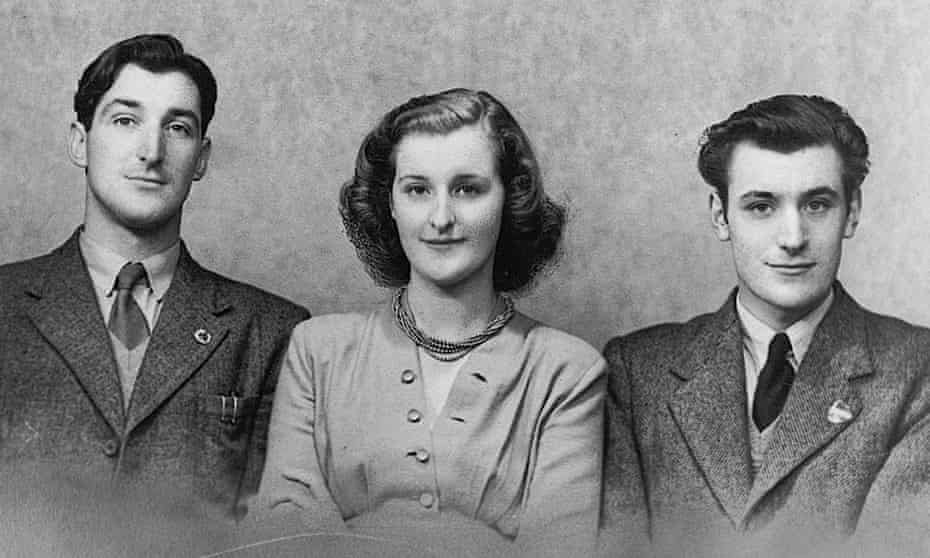
Olwyn Hughes, centre, with her brothers, Ted, right, and Gerald. Gerald, Olwyn,Ted Hughes

Crow's Nerve Fails

Crow, feeling his brain slip, 
Finds his every feather the fossil of a murder. 

Who murdered all these? 
These living dead, that root in his nerves and his blood 
Till he is visibly black? 

How can he fly from his feathers? 
And why have they homed on him? 

Is he the archive of their accusations? 
Or their ghostly purpose, their pining vengeance? 
Or their unforgiven prisoner? 

He cannot be forgiven. 

His prison is the earth. Clothed in his conviction, 
Trying to remember his crimes 

Heavily he flies.


Wednesday, January 12, 2022

Christopher Logue


Christopher Logue


Cold Calls: War Music, Continued


Many believe in the stars.  


Take Quinamid  
The son of a Dardanian astrologer  
Who disregarded what his father said  
And came to Troy in a taxi.  

Gone.  


Odysseus to Greece:  

“Hector has never fought this far from Troy.  
We want him further out. Beyond King Ilus’ tower.  
So walk him to the centre of the plain and, having killed him,  
Massacre the Trojans there.”  

“Ave!”  


Immediately beyond the ridge is Primrose Hill  
Where Paris favoured Aphrodité.  

“Take it,” said Hector.  

Greece shouted: “Hurry up!”  
Troy shouted: “Wait for us!”  

Christopher Logue

Image


All Day Permanent Red [to Welcome Hector To His Death]


o welcome Hector to his death 
God sent a rolling thunderclap across the sky 
The city and the sea 
And momentarily— 
The breezes playing with the sunlit dust— 
On either slope a silence fell. 

Think of a raked sky-wide Venetian blind. 
Add the receding traction of its slats 
Of its slats of its slats as a hand draws it up. 
Hear the Greek army getting to its feet. 

Then of a stadium when many boards are raised 
And many faces change to one vast face. 
So, where there were so many masks, 
Now one Greek mask glittered from strip to ridge. 
Already swift 
Boy Lutie took Prince Hector's nod 
And fired his whip that right and left 

Signalled to Ilium's wheels to fire their own, 
And to the Wall-wide nodding plumes of Trojan infantry— 

Flutes! 
Flutes! 
Screeching above the grave percussion of their feet 
Shouting how they will force the savage Greeks 
Back up the slope over the ridge, downplain 
And slaughter them beside their ships— 

Add the reverberation of their hooves: and 
'Reach for your oars. . .' 
T'lesspiax, his yard at 60°, sending it 
Across the radiant air as Ilium swept 
Onto the strip 
Into the Greeks 

Over the venue where 
Two hours ago all present prayed for peace. 
And carried Greece 
Back up the slope that leads 
Via its ridge 

Onto the windy plain. 

Sunday, January 9, 2022

Christopher Logue


Christopher Logue in youth

Christopher Logue in you

from WAR MUSIC

An account of books 16-19 of the Iliad by Homer. 

  Down on your knees, Achilles.  Farther down.
Now forward on your hands and put your face into the dirt,
And scrub it to and fro.
  Grief has you by the hair with one
And with the forceps of its other hand
Uses your mouth to trowel the dogshit up;
Watches you lift your arms to Heaven; and then
Pounces and screws your nose into the filth.
  Gods have plucked drawstrings from your head,
And from the templates of your upper lip
Modelled their bows.
  Not now.  Not since
Your grieving reaches out and pistol-whips
That envied face, until
Frightened to bear your black, backbreaking agony alone,
You sank, throat back, thrown back, your voice
Thrown out across the sea to reach your Source.

Thursday, December 30, 2021

David Mitchell


David Mitchell


from Utopia Avenue

1
Abandon Hope

Dean hurries past the phoenix theatre, dodges a blind man in dark glasses, steps onto Charing Cross Road to overtake a slow-­moving woman and pram, leaps a grimy puddle, and swerves into Denmark Street where he skids on a sheet of black ice. His feet fly up. He's in the air long enough to see the gutter and sky swap places and to think, This'll bloody hurt, before the pavement slams his ribs, kneecap, and ankle. It bloody hurts. Nobody stops to help him up. Bloody London. A bewhiskered stockbroker type in a bowler hat smirks at the long-­haired lout's misfortune and is gone. Dean gets to his feet, gingerly, ignoring the throbs of pain, praying that nothing's broken. Mr. Craxi doesn't do sick pay. His wrists and hands are working, at least. The money. He checks that his bankbook with its precious cargo of ten five-­pound notes is safe in his coat pocket. All's well. He hobbles along. He recognizes Rick "One Take" Wakeman in the window of the Gioconda café across the street. Dean wishes he could join Rick for a cuppa, a smoke, and a chat about session work, but Friday morning is rent-­paying morning, and Mrs. Nevitt is waiting in her parlor like a giant spider. Dean's cutting it fine this week, even by his standards. Ray's bank order only arrived yesterday, and the queue to cash it just now took forty minutes, so he pushes on, past Lynch & Lupton's Music Publishers, where Mr. Lynch told Dean all his songs were shit, except the few that were drivel. Past Alf Cummings Music Management, where Alf Cummings put his podgy hand on Dean's inner thigh and murmured, "We both know what I can do for you, you beautiful bastard; the question is, What will you do for me?," and past Fungus Hut Studios, where Dean was due to record a demo with Battleship Potemkin before the band booted him out.

Wednesday, December 29, 2021

Philip Larkin


https://static.tvtropes.org/pmwiki/pub/images/philip_larkin.jpeg


An Arundel Tomb

Side by side, their faces blurred,
The earl and countess lie in stone,
Their proper habits vaguely shown
As jointed armour, stiffened pleat,
And that faint hint of the absurd –
The little dogs under their feet.

Such plainness of the pre-baroque
Hardly involves the eye, until
It meets his left-hand gauntlet, still
Clasped empty in the other; and
One sees, with a sharp tender shock,
His hand withdrawn, holding her hand.

They would not think to lie so long.
Such faithfulness in effigy
Was just a detail friends would see:
A sculptor’s sweet commissioned grace
Thrown off in helping to prolong
The Latin names around the base.

They would no guess how early in
Their supine stationary voyage
The air would change to soundless damage,
Turn the old tenantry away;
How soon succeeding eyes begin
To look, not read. Rigidly they

Persisted, linked, through lengths and breadths
Of time. Snow fell, undated. Light
Each summer thronged the grass. A bright
Litter of birdcalls strewed the same
Bone-littered ground. And up the paths
The endless altered people came,

Washing at their identity.
Now, helpless in the hollow of
An unarmorial age, a trough
Of smoke in slow suspended skeins
Above their scrap of history,
Only an attitude remains:

Time has transfigures them into
Untruth. The stone fidelity
They hardly meant has come to be
Their final blazon, and to prove
Our almost-instinct almost true:
What will survive of us is love.


Saturday, December 25, 2021

Ted Hughes


Crow's Fall

When Crow was white he decided the sun was too white.
He decided it glared much too whitely.
He decided to attack it and defeat it.

He got his strength up flush and in full glitter.
He clawed and fluffed his rage up.
He aimed his beak direct at the sun's centre.

He laughed himself to the centre of himself

And attacked.

At his battle cry trees grew suddenly old,
Shadows flattened.

But the sun brightened—
It brightened, and Crow returned charred black.

He opened his mouth but what came out was charred black.

"Up there," he managed,
"Where white is black and black is white, I won."

Wednesday, December 15, 2021

Rosemary Tonks


Rosemary Tonks in The Observer (60s)


Badly Chosen Lover


Criminal, you took a great piece of my life, 

And you took it under false pretences, 
That piece of time 
- In the clear muscles of my brain 
I have the lens and jug of it! 
Books, thoughts, meals, days, and houses, 
Half Europe, spent like a coarse banknote, 
You took it — leaving mud and cabbage stumps. 

And, Criminal, I damn you for it (very softly).

My spirit broke her fast on you. And, Turk, 
You fed her with the breath of your neck 
- In my brain's clear retina 
I have the stolen love-behaviour. 
Your heart, greedy and tepid, brothel-meat, 
Gulped it, like a flunkey with erotica. 
And very softly, Criminal, I damn you for it.


Rosemary Tonks


Tuesday, November 2, 2021

Rosemary Tonks


Rosemary Tonks ‘evaporated into air like the Cheshire cat’

DRESSING-GOWN OLYMPIAN

I insist on vegetating here 
In motheaten granduer. Haven't I plotted 
Like a madman to get here? Well then. 


These free days, these side-streets, 
Mouldy or shiny, with their octoroon light: 
Also, I have grudges, enemies, a religion, 
Politics, a new morality - everything! 

Kept awake by alcohol and coffee, 
Inside her oriental dressing-gown of dust 
My soul is always thinking things over, thoroughly. 
No wonder my life has grandeur, depth, and crust. 


Ah, to desire a certain way of life, 
And then to gain it! 
What a mockery, what absolute misery,

Dressing-gown hours the tint of alcohol or coffee. 


Am I an imbecile of the first water after all? 
Yes, I think I can claim - now that all this grandeur, 
Depth, and crust is stacked around me - that I am.


Stevie Smith


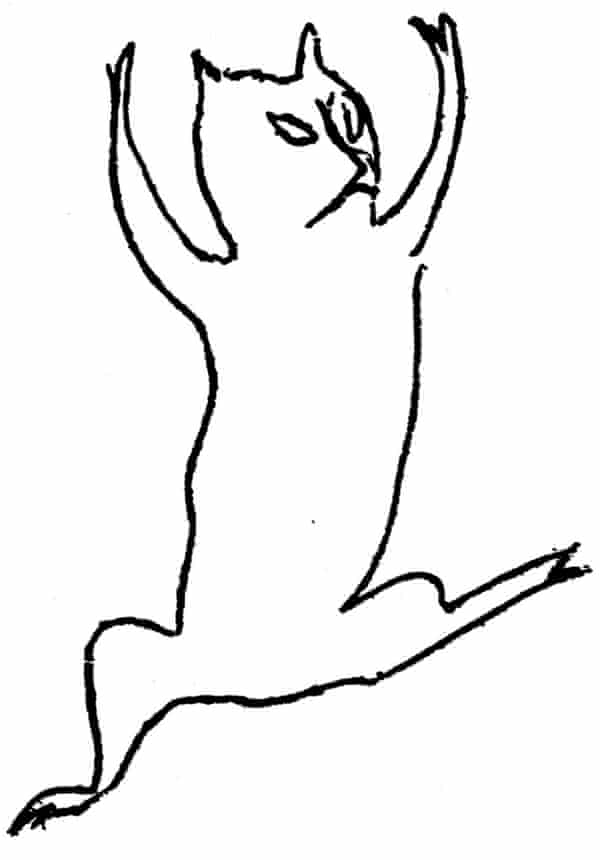
 Illustration by Stevie Smith


Valuable, by Stevie Smith

         After reading two paragraphs in a newspaper.

All these illegitimate babies...
Oh girls, girls,
Silly little cheap things,
Why do you not put some value on yourselves,
Learn to say, No?
Did nobody teach you?
Nobody teaches anybody to say No nowadays,
People should teach people to say No.

Oh poor panther,
Oh you poor black animal,
At large for a few moments in a school for young children in Paris,
Now in your cage again,
How your great eyes bulge with bewilderment,
There is something there that accuses us,
Something that says:
I am too valuable to be kept in a cage.

Oh these illegitimate babies!
Oh girls, girls,
Silly little valuable things,
You should have said, No, I am valuable,
And again, It is because I am valuable
I say, No.

Nobody teaches anybody they are valuable nowadays.

Girls, you are valuable,
And you, Panther, you are valuable,
But the girls say: I shall be alone
If I say 'I am valuable' and other people do not say it of me,
I shall be alone, there is no comfort there.
No, it is not comforting but it is valuable,
And if everybody says it in the end
It will be comforting. And for the panther too,
If everybody says he is valuable
It will be comforting for him.


W. H. Auden


W. H. Auden

O Where Are You Going?

    "O where are you going?" said reader to rider,
    "That valley is fatal where furnaces burn,
    Yonder's the midden whose odours will madden,
    That gap is the grave where the tall return."

    "O do you imagine," said fearer to farer,
    "That dusk will delay on your path to the pass,
    Your diligent looking discover the lacking,
    Your footsteps feel from granite to grass?"

    "O what was that bird," said horror to hearer,
    "Did you see that shape in the twisted trees?
    Behind you swiftly the figure comes softly,
    The spot on your skin is a shocking disease."

    "Out of this house"---said rider to reader,
    "Yours never will"---said farer to fearer
    "They're looking for you"---said hearer to horror,
    As he left them there, as he left them there.

If I Could Tell You

Time will say nothing but I told you so,
Time only knows the price we have to pay;
If I could tell you I would let you know.

If we should weep when clowns put on their show,
If we should stumble when musicians play,
Time will say nothing but I told you so.

There are no fortunes to be told, although,
Because I love you more than I can say,
If I could tell you I would let you know.

The winds must come from somewhere when they blow,
There must be reasons why the leaves decay;
Time will say nothing but I told you so.

Perhaps the roses really want to grow,
The vision seriously intends to stay;
If I could tell you I would let you know.

Suppose all the lions get up and go,
And all the brooks and soldiers run away;
Will Time say nothing but I told you so?
If I could tell you I would let you know.


W. H. Auden


 Photograph by Richard Avedon


At Last the Secret is Out

At last the secret is out,
as it always must come in the end,
the delicious story is ripe to tell
to tell to the intimate friend;
over the tea-cups and into the square
the tongues has its desire;
still waters run deep, my dear,
there's never smoke without fire.

Behind the corpse in the reservoir,
behind the ghost on the links,
behind the lady who dances
and the man who madly drinks,
under the look of fatigue
the attack of migraine and the sigh
there is always another story,
there is more than meets the eye.

For the clear voice suddenly singing,
high up in the convent wall,
the scent of the elder bushes,
the sporting prints in the hall,
the croquet matches in summer,
the handshake, the cough, the kiss,
there is always a wicked secret,
a private reason for this.

W. H. Auden

Christopher Isherwood; W.H. Auden, by Keystone Press Agency Ltd - NPG x137621


Leap Before You Look


The sense of danger must not disappear:
The way is certainly both short and steep,
However gradual it looks from here;
Look if you like, but you will have to leap.

Tough-minded men get mushy in their sleep
And break the by-laws any fool can keep;
It is not the convention but the fear
That has a tendency to disappear.

The worried efforts of the busy heap,
The dirt, the imprecision, and the beer
Produce a few smart wisecracks every year;
Laugh if you can, but you will have to leap.

The clothes that are considered right to wear
Will not be either sensible or cheap,
So long as we consent to live like sheep
And never mention those who disappear.

Much can be said for social savoir-faire,
But to rejoice when no one else is there
Is even harder than it is to weep;
No one is watching, but you have to leap.

A solitude ten thousand fathoms deep
Sustains the bed on which we lie, my dear:
Although I love you, you will have to leap;
Our dream of safety has to disappear.

                                                            December 1940

George Gordon Lord Byron


Tuesday, December 14, 2021

George Gordon Lord Byron


The Destruction of Sennacherib


The Assyrian came down like the wolf on the fold,
And his cohorts were gleaming in purple and gold;
And the sheen of their spears was like stars on the sea,
When the blue wave rolls nightly on deep Galilee.
Like the leaves of the forest when Summer is green,
That host with their banners at sunset were seen:
Like the leaves of the forest when Autumn hath blown,
That host on the morrow lay wither’d and strown.
For the Angel of Death spread his wings on the blast,
And breathed in the face of the foe as he pass’d;
And the eyes of the sleepers wax’d deadly and chill,
And their hearts but once heaved, and for ever grew still!
And there lay the steed with his nostril all wide,
But through it there roll’d not the breath of his pride:
And the foam of his gasping lay white on the turf,
And cold as the spray of the rock-beating surf.
And there lay the rider distorted and pale,
With the dew on his brow and the rust on his mail;
And the tents were all silent, the banners alone,
The lances unlifted, the trumpet unblown.
And the widows of Ashur are loud in their wail,
And the idols are broke in the temple of Baal;
And the might of the Gentile, unsmote by the sword,
Hath melted like snow in the glance of the Lord!


Cecil Day-Lewis


r/OldSchoolCool - Daniel Day-Lewis (right) with his father Cecil, late 1960s.

                With son Daniel


Walking Away


It is eighteen years ago, almost to the day –
A sunny day with leaves just turning,
The touch-lines new-ruled – since I watched you play
Your first game of football, then, like a satellite
Wrenched from its orbit, go drifting away
Behind a scatter of boys. I can see
You walking away from me towards the school
With the pathos of a half-fledged thing set free
Into a wilderness, the gait of one
Who finds no path where the path should be.
That hesitant figure, eddying away
Like a winged seed loosened from its parent stem,
Has something I never quite grasp to convey
About nature’s give-and-take – the small, the scorching
Ordeals which fire one’s irresolute clay.
I have had worse partings, but none that so
Gnaws at my mind still. Perhaps it is roughly
Saying what God alone could perfectly show –
How selfhood begins with a walking away,
And love is proved in the letting go.

Barbara Guest

  Santa Fe Trail I go separately The sweet knees of oxen have pressed a path for me ghosts with ingots have burned their bare hands it is th...