Showing posts with label modernist. Show all posts

Sunday, February 27, 2022

John Ashbery on Gertrude Steib


Perhaps the word that occurs oftenest in the Stanzas is the word "they," for this is a poem about the world, about "them." (What a pleasant change from the eternal "we" with which so many modern poets automatically begin each sentence, and which gives the impression that the author is sharing his every sensation with some invisible Kim Novak.) Less frequently, "I" enters to assess the activities of "them," to pick up after them, to assert his own altered importance. As we get deeper into the poem, it seems not so much as if we were reading as living a rather long period of our lives with a houseful of people. Like people, Miss Stein's lines are comforting or annoying or brilliant or tedious. Like people, they sometimes make no sense and sometimes make perfect sense; or they stop short in the middle of a sentence and wander away, leaving us alone for awhile in the physical world, that collection of thoughts, flowers, weather, and proper names. And, just as with people, there is no real escape from them: one feels that if one were to close the book one would shortly re-encounter the Stanzas in life, under another guise. As the author says, "It is easily eaten hot and lukewarm and cold / But not without it."

Stanzas in Meditation gives one the feeling of time passing, of things happening, of a "plot," though it would be difficult to say precisely what is going on. Sometimes the story has the logic of a dream:

She asked could I be taught to be allowed
And I said yes oh yes I had forgotten him
And she said does any or do any change
And if not I said whom could they count.

while at other times it becomes startlingly clear for a moment, as though a change in the wind had suddenly enabled us to hear a conversation that was taking place some distance away:

He came early in the morning.
He thought they needed comfort
Which they did
And he gave them an assurance
That it would be all as well
As indeed were it
Not to have it needed at any time

But it is usually not events which interest Miss Stein, rather it is their "way of happening," and the story of Stanzas in Meditation is a general, all-purpose model which each reader can adapt to fit his own set of particulars. The poem is a hymn to possibility; a celebration of the fact that the world exists, that things can happen.

In its profound originality, its original profundity, this poem that is always threatening to become a novel reminds us of the late novels of James, especially The Golden Bowl and The Sacred Fount, which seem to strain with a superhuman force toward "the condition of music," of poetry. In such a passage as the following, for instance:

Be not only without in any of their sense
Careful
Or should they grow careless with remonstrance
Or be careful just as easily not at all
As when they felt.
They could or would would they grow always
By which not only as more as they like.
They cannot please conceal
Nor need they find they need a wish

we are not far from Charlotte's and the Prince's rationalizations. Both Stanzas in Meditation and The Golden Bowl are ambitious attempts to transmit a completely new picture of reality, of that real reality of the poet which Antonin Artaud called "une realite dangereuse et typique." If these works are highly complex and, for some, unreadable, it is not only because of the complicatedness of life, the subject, but also because they actually imitate its rhythm, its way of happening, in an attempt to draw our attention to another aspect of its true nature. Just as life is being constantly altered by each breath one draws, just as each second of life seems to alter the whole of what has gone before, so the endless process of elaboration which gives the work of these two writers a texture of bewildering luxuriance -- that of a tropical rain-forest of ideas -- seems to obey some rhythmic impulse at the heart of all happening.

In addition, the almost physical pain with which we strive to accompany the evolving thought of one of James's or Gertrude Stein's characters is perhaps a counterpart of the painful continual projection of the individual into life. As in life, perseverance has its rewards -- moments when we emerge suddenly on a high plateau with a view of the whole distance we have come. In Miss Stein's work the sudden inrush of clarity is likely to be an aesthetic experience, but (and this seems to be another of her "points") the description of that experience applies also to "real-life" situations, the aesthetic problem being a microcosm of all human problems.

I should think it makes no difference
That so few people are me.
That is to say in each generation there are so few geniuses

And why should I be one which I am
This is one way of saying how do you do
There is this difference
I forgive you everything and there is nothing to forgive.

It is for moments like this that one perseveres in this difficult poem, moments which would be less beautiful and meaningful if the rest did not exist, for we have fought side by side with the author in her struggle to achieve them.

Thursday, February 17, 2022

Wallace Stevens

Wallace Stevens, right, with Robert Frost in Key West, circa 1940.

with Robert Frost, Key West, ca. 1940>

 Invective Against Swans

The soul, O ganders, flies beyond the parks
And far beyond the discords of the wind.
 
A bronze rain from the sun descending marks
The death of summer, which that time endures
 
Like one who scrawls a listless testament
Of golden quirks and Paphian caricatures,
 
Bequeathing your white feathers to the moon
And giving your bland motions to the air.
 
Behold, already on the long parades
The crows anoint the statues with their dirt.
 
And the soul, O ganders, being lonely, flies
Beyond your chilly chariots, to the skies.
 

Wallace Stevens


Depression Before Spring

The cock crows
But no queen rises.

The hair of my blonde
Is dazzling,
As the spittle of cows
threading the wind.

Ho! Ho!

But ki-ki-ri-ki
Brings no rou-cou,
No rou-cou-cou.

But no queen comes
In slipper green.

Wednesday, January 19, 2022

William Carlos Williams


Free first page 


at the small end of an illness
there was a picture
probably Japanese
which filled my eye

an idiotic picture
except it was all I recognized
the wall lived for me in that picture
I clung to it as a fly

From “Pictures From Brueghel and Other Poems,” 1962.


Friday, January 7, 2022

Gert Gerty Get Gertrude


Gertrude Stein on Writing: a list [in process] 

1926Compositon as Explanation/Descriptions of Literature1927An Elucidation1929An Acquaintance with Description1931Saving the Sentence/Sentences and Paragraphs/Arthur, a Grammar/A Grammarian/Sentences/Regular regularly, in narrative/Finally George, a vocabulary of Thinking/Forensics1935What is English Literature/Pictures/Plays/The Gradual Making of Making of Americans/Portraits and Repetitions/Poetry & Grammar/Narration, Lectures 1-4/How Writing is Written1937Why I Like Detective Stories1940What are Masterpieces1946A transatlantic Interview1895/1949Radcliffe Themes 


“Composition as Explanation (1926) 6pp. 
[Written and delivered as a lecture at Oxford, 1926. Published 
in the Dial (October 1926) and in Composition as Explanation 
(Hogarth Press, 1926). Text also included in What are Masterpieces (1940), Selected Writings (1946), Writings and Lectures, 1911-1946 (1967) and in the Library of America Gertrude Stein: Writings 1903-1932 (1999). 


“Descriptions of Literature” (1926) 8pp. 
[Published as Stable Pamphlet no. 2 by George Platt Lynes and Adlai Harbeck, Englewood New Jersey, also published in transition (Summer 1928) and in Reflections on the Atom Bomb in 1973] 


“An Elucidation” (1927) 16pp. 
[Originally published in transition no. 1 (April 1927) and published in a corrected version as a pamphlet the same year, also included in A Primer for the Gradual Understanding (1971) 


"An Acquaintance with Description" (1929) 
Published and hand set by Robert Graves and Laura Riding (Mallorca, Seizin Press, 1929, and included in Library of America Gertrude Stein: Writings 1903-1932 (1999). 


How to Write (1931) 
"A difference between a noun and a verb is not seen in wishes and wishes" 
[This collection originally published in Paris by her own Plain Edition Press, and later (1973) reprinted by the Something Else Press and again in 1975 by Dover.] It includes, all first published here: 
“Saving the Sentence” 
“Sentences and Paragraphs” 
“Arthur, a Grammar” 
“A grammarian” 
“Sentences” 
“Regular regularly, in Narrative” 
“Finally, George, a vocabulary of Thinking” 
“Forensics” 


Lectures in America (1935) 
"Gerty Gerty Stein is Back Home Home Back" (newspaper headline). 
[These lectures were written for Stein's American lecture tour of 1934-35. She and Toklas arrived in New York City on October 24, 1934 and in the course of six months Stein delivered over 40 lectures. Stein and Toklas left for Europe on May 4, 1935]. 
Included in this volume and first published here, are: 
“What is English Literature” 
“Pictures” 
“Plays” 
“The Gradual Making of Making of Americans” 
“Portraits and Repetitions” 
“Poetry & Grammar” 
[All but “Plays” are included in Writings and Lectures, 1911-1946, no. 10 below] 


Narration (1935) 
[This collection of four lectures written while on her lecture tour in 1934-35 was first published by the University of Chicago Press in 1935. The Lectures are numbered 1 through 4] 
Lecture 1 “The contrast between the English daily life and the American lack of a daily life” 
Lecture 2 'Narrative in prose and narrative in poetry” 
Lecture 3 “History and the newspaper as narrative” 
Lecture 4 “The Audience and the Novel and the Mystery Story as narrative” 


What are Masterpieces (1940) 
[First published in Los Angeles by Conference Press in 1940, this includes addresses delivered before the Cambridge and Oxford Literary Societies] 
Includes: 
“Composition as Explanation” [originally published in 1926, see above] 
“What are Masterpieces and why are there so few of them” [first published here] 


Selected Writings of Gertrude Stein (1946) 
[Edited by Carl Van Vechten and first published by Random House in 1946 in 10,000 copies and in 1962 as Modern Library Book ML322 in 7,500 copies] 
Includes: 
“The Gradual Making of the Making of Americans” [originally published in Lectures in America (1935), 
see above] 
“Composition as Explanation” [originally published in 1926, see above] 

10 
Writings and Lectures, 1911-1945 (1967) 
[Edited by Patricia Meyrowitz published in Londoon by Peter Owen in 1967 and reprinted by Penguin in 1971 as Look at Me Now and Here I Am] 
Includes: 
“Composition as Explanation”[originally published in 1926, see above] 
“What is English Literature” 
“The Gradual Making of the Making of Americans” 
“Portraits and Repetitions” 
“Poetry and Grammar” 
“What are Masterpieces and why are there so few of them” [originally published in 1940, see above] 
“Henry James” [originally published in Four in America (1947)] 
[All but “Composition as Explanation,” “What are Masterpieces” and “Henry James” published in 
Lectures in America (1935), see above] 

10 
A Primer for the Gradual Understanding of Gertrude Stein (1971) 
[Edited by Robert Bartlett Hass and published in Los Angeles by Black Sparrow Press in 1971] 
Includes: 
“A Transatlantic Interview” [interview done in 1946] 
"Radcliffe Themes 91895)" [originally published in Gertrude Stein: Form and Intelligibility, by Rosalind S. 
Miller. Exposition Press, 1949] 
“An Elucidation” [originally published in transition, April 1927 with garbled text and reissued correctly as 
a pamphlet in April 1927] 

11 
How Writing is Written (1974) 
[Edited by Robert Bartlett Hass and published by Black Sparrow Press in 1974] 
Includes; 
“Why I like Detective Stories” [originally published in Harper's Bazaar,November 1937] 
“How Writing is Written” [originally delivered as a lecture on January 12, 1935 at Choate School and 
published in Choate Literary Magazine, February 1935] 


Thursday, January 6, 2022

Gertrude Stein

 Gertrude Stein, right, and Alice B. Toklas in 1922 in their art-filled apartment in Paris.

Alice, Gertrude, 1922


I love my love with a v 
Because it is like that 
I love my love with a b 
Because I am beside that 
A king. 
I love my love with an a 
Because she is a queen 
I love my love and a a is the best of them 
Think well and be a king, 
Think more and think again 
I love my love with a dress and a hat 
I love my love and not with this or with that 
I love my love with a y because she is my bride 
I love her with a d because she is my love beside 
Thank you for being there 
Nobody has to care 
Thank you for being here 
Because you are not there. 

And with and without me which is and without she she can be late and then and how and all around we think and found that it is time to cry she and I.


Gertrude Stein

 Gertrude Stein, in a Man Ray portrait, was a shaper of Modernism.

                                Photograph by Man Ray

from Tender Buttons


CHICKEN. 

Pheasant and chicken, chicken is a peculiar third. 

CHICKEN. 

Alas a dirty word, alas a dirty third alas a dirty third, alas a dirty bird. 

CHICKEN. 

Alas a doubt in case of more go to say what it is cress. What is it. Mean. Why. Potato. Loaves. 

CHICKEN. 

Stick stick call then, stick stick sticking, sticking with a chicken. Sticking in a extra succession, sticking in.

Gertrude Stein


Guillaume Apollinaire

Give known or pin ware. 
Fancy teeth, gas strips. 
Elbow elect, sour stout pore, pore caesar, pour state at. 
Leave eye lessons I. Leave I. Lessons. I. Leave I lessons, I.

Gertrude Stein


Cézanne

The Irish lady can say, that to-day is every day. Caesar can say that 
every day is to-day and they say that every day is as they say. 
In this way we have a place to stay and he was not met because 
he was settled to stay. When I said settled I meant settled to stay. 
When I said settled to stay I meant settled to stay Saturday. In this 
way a mouth is a mouth. In this way if in as a mouth if in as a 
mouth where, if in as a mouth where and there. Believe they have 
water too. Believe they have that water too and blue when you see 
blue, is all blue precious too, is all that that is precious too is all 
that and they meant to absolve you. In this way Cézanne nearly did 
nearly in this way. Cézanne nearly did nearly did and nearly did. 
And was I surprised. Was I very surprised. Was I surprised. I was 
surprised and in that patient, are you patient when you find bees. 
Bees in a garden make a specialty of honey and so does honey. Honey 
and prayer. Honey and there. There where the grass can grow nearly 
four times yearly.

Gertrude Stein


gertrude stein and her poodle, basket, at pierre balmain's fashion show by horst p. horst

        `                    GERTRUDE, BASKET AND Pierre Balmain GOWN


Stanzas in Meditation: Stanza  5


Why can pansies be their aid or paths.   
He said paths she had said paths
All like to do their best with half of the time   
A sweeter sweetener came and came in time   
Tell him what happened then only to go
He nervous as you add only not only as they angry were   
Be kind to half the time that they shall say
It is undoubtedly of them for them for every one any one   
They thought quietly that Sunday any day she might not come
In half a way of coining that they wish it
Let it be only known as please which they can underrate   
They try once to destroy once to destroy as often
Better have it changed to pigeons now if the room smokes   
Not only if it does but happens to happens to have the room smoke all the time.
In their way not in their way it can be all arranged
Not now we are waiting.
I have read that they wish if land is there   
Land is there if they wish land is there   
Yes hardly if they wish land is there
It is no thought of enterprise there trying   
Might they claim as well as reclaim.   
Did she mean that she had nothing.   
We say he and I that we do not cry
Because we have just seen him and called him back
He meant to go away
Once now I will tell all which they tell lightly.
How were we when we met.
All of which nobody not we know   
But it is so. They cannot be allied
They can be close and chosen.   
Once in a while they wait.
He likes it that there is no chance to misunderstand pansies.


Ezra Pound


Ezra Pound


"Don't use such an expression as "dim lands of peace." It dulls the image. It mixes an abstraction with the concrete. It comes from the writer's not realizing that the natural object is always the adequate symbol." 

"Go in fear of abstractions. Do not retell in mediocre verse what has already been done in good prose. Don't think any intelligent person is going to be deceived when you try to shirk all the difficulties of the unspeakably dificult art of good prose by chopping your compostion into line lengths."

----------------Ezra Pound. from "A Retrospect" in Pavannes and Divigations (1918)

Ezra Pound


[Ezra Pound at William Carlos Williams' house in 1958 by Richard Avedon]

        Ezra Pound at William Carlos Williams' house in 1958 by Richard Avedon


Canto XIII

Kung walked
by the dynastic temple
and into the cedar grove,
and then out by the lower river,
And with him Khieu Tchi
and Tian the low speaking
And "we are unknown," said Kung,
"You will take up charioteering?
"Then you will become known,
"Or perhaps I should take up charioterring, or archery?
"Or the practice of public speaking?"
And Tseu-lou said, "I would put the defences in order,"
And Khieu said, "If I were lord of a province
"I would put it in better order than this is."
And Tchi said, "I would prefer a small mountain temple,
"With order in the observances,
with a suitable performance of the ritual,"
And Tian said, with his hand on the strings of his lute
The low sounds continuing
after his hand left the strings,
And the sound went up like smoke, under the leaves,
And he looked after the sound:
"The old swimming hole,
"And the boys flopping off the planks,
"Or sitting in the underbrush playing mandolins."
And Kung smiled upon all of them equally.
And Thseng-sie desired to know:
"Which had answered correctly?"
And Kung said, "They have all answered correctly,
"That is to say, each in his nature."
And Kung raised his cane against Yuan Jang,
Yuan Jang being his elder,
or Yuan Jang sat by the roadside pretending to
be receiving wisdom.
And Kung said
"You old fool, come out of it,
"Get up and do something useful."
And Kung said
"Respect a child's faculties
"From the moment it inhales the clear air,
"But a man of fifty who knows nothing
Is worthy of no respect."
And "When the prince has gathered about him
"All the savants and artists, his riches will be fully employed."
And Kung said, and wrote on the bo leaves:
If a man have not order within him
He can not spread order about him;
And if a man have not order within him
His family will not act with due order;
And if the prince have not order within him
He can not put order in his dominions.
And Kung gave the words "order"
and "brotherly deference"
And said nothing of the "life after death."
And he said
"Anyone can run to excesses,
"It is easy to shoot past the mark,
"It is hard to stand firm in the middle."
And they said: If a man commit murder
Should his father protect him, and hide him?
And Kung said:
He should hide him.
And Kung gave his daughter to Kong-Tchang
Although Kong-Tchang was in prison.
And he gave his niece to Nan-Young
although Nan-Young was out of office.
And Kung said "Wan ruled with moderation,
"In his day the State was well kept,
"And even I can remember
"A day when the historians left blanks in their writings,
"I mean, for things they didn't know,
"But that time seems to be passing.
A day when the historians left blanks in their writings,
But that time seems to be passing."
And Kung said, "Without character you will
"be unable to play on that instrument
"Or to execute the music fit for the Odes.
"The blossoms of the apricot
"blow from the east to the west,
"And I have tried to keep them from falling."


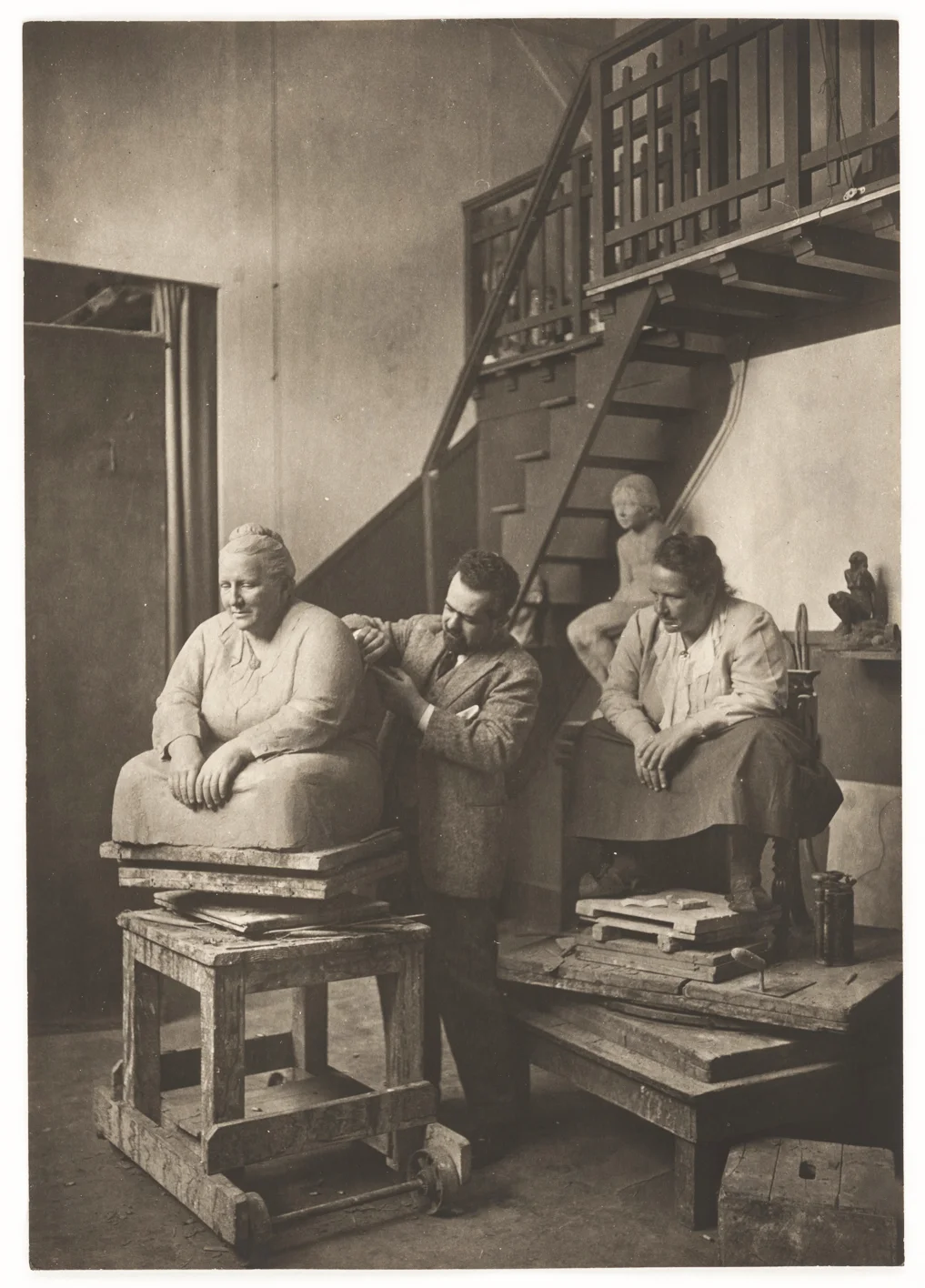
Gertrude Stein


Man Ray, Gertrude Stein posing for Jo Davidson, 1922, gelatin silver print. Courtesy of the National Portrait Gallery, Smithsonian Institution, © 2010 Man Ray Trust / Artists Rights Society (ARS), New York / ADAGP, Paris.


    Man Ray. Gertrude Stein posing for Jo Davidson


ORANGE.
Why is a feel oyster an egg stir. Why is it orange centre.
A show at tick and loosen loosen it so to speak sat.
It was an extra leaker with a see spoon, it was an extra licker with a see spoon.

ORANGE.
A type oh oh new new not no not knealer knealer of old show beefsteak, neither neither.

ORANGES.
Build is all right.

ORANGE IN.
Go lack go lack use to her.
Cocoa and clear soup and oranges and oat-meal.
Whist bottom whist close, whist clothes, woodling.
Cocoa and clear soup and oranges and oat-meal.
Pain soup, suppose it is question, suppose it is butter, real is, real is only, only excreate, only excreate a no since.
A no, a no since, a no since when, a no since when since, a no since when since a no since when since, a no since, a no since when since, a no since, a no, a no since a no since, a no since, a no since.

Tender Buttons. (From "Food") 1914

Wednesday, January 5, 2022

Delmore Schwartz


        his copy of Finnegan's Wake


Delmore Schwartz must have spent more timthinking about Finnegans Wake than almost anybody else. Yet it's a shame he wrote very little about the book. I've found just one essay, 'The Vocation of the Poet in the Modern World', written in 1951, in which he talks about what the Wake meant to him:

'Joyce had completed his last and probably his best book, the stupendous Finnegans Wake, a book which would itself provide sufficient evidence and illustration of the vocation of the modern poet in modern life. All that has been observed in Eliot's work is all the more true of Finnegans Wake – the attention to colloquial speech, the awareness of the variety of ways that languages can be degraded, and how that degradation can be the base for a new originality and exactitude, the sense of an involvement with theinternational scene and all history. But more than that, the radio and even televisionplay a part in this wonderful book, as indeed they played a part in the writing of it. Joyce had a short wave radio with which he was able to hear London, Moscow, Dublin – and New York!  In Finnegans Wake, I was perplexed for a time by echoes of American radio comedy and Yiddish humor until I learned about Joyce's radio and about his daily reading of the Paris edition of the New York Herald-Tribune.' The most important point of all, however, is that Finnegans Wake exhibits in the smallest detail and in the entire scope of the work the internationality of the modern poet, his involvement in all history, and his consciousness of the impingement of any foreign language from Hebrew to Esperanto upon the poet's use of the English language.....'

Saturday, December 25, 2021

Ezra Pound


Abu Salammamm

A SONG OF EMPIRE
Great is King George the Fifth,
for he has chained me to this fountain;
He feeds me with beef-bones and wine.
Great is King George the Fifth
His palace is white like marble,
His palace has ninety-eight windows,
His palace is like a cube cut in thirds,
It is he who has slain the Dragon
and released the maiden Andromeda.
Great is King George the Fifth;
For his army is legion,
His army is a thousand and forty-eight soldiers
with red cloths about their buttocks,
And they have red faces like bricks.
Great is the King of England and greatly to be feared,
For he has chained me to this fountain;
He provides me with women and drinks.
Great is King George the Fifth
and very resplendent is this fountain.
It is adorned with young gods riding upon dolphins
And its waters are white like silk.
Great and Lofty is this fountain;
And seated upon it is the late Queen, Victoria,
The Mother of the great king, in a hoop-skirt,
  Like a woman heavy with child.

Oh may the king live forever!
Oh may the king live for a thousand years!
For the young prince is foolish and headstrong;
He plagues me with jibes and sticks,
And when he comes into power
He will undoubtedly chain someone else to this fountain,
And my glory will
Be at an end.


Ezra Pound


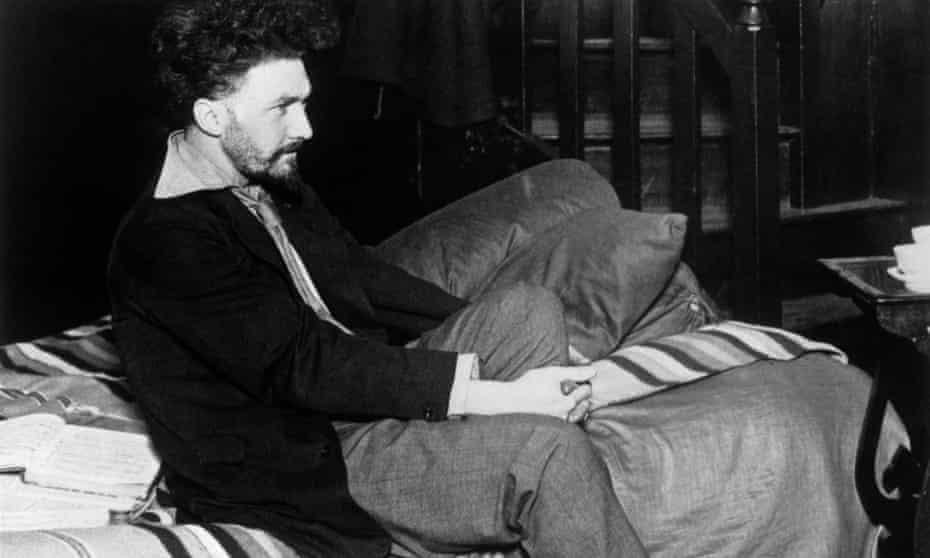
American poet and critic Ezra Pound sitting on his bed in his Paris studio in 1923.

                                                                            1922

from Canto XVI

And before hell mouth; dry plain
and two mountains;
On the one mountain, a running form,
and another
In the turn of the hill; in hard steel
The road like a slow screw's thread,
The angle almost imperceptible,
so that the circuit seemed hardly to rise;
And the running form, naked, Blake,
Shouting, whirling his arms, the swift limbs,
Howling against the evil,
his eyes rolling,
Whirling like flaming cart-wheels,
and his head held backward to gaze on the evil
As he ran from it,
to be hid by the steel mountain,
And when he showed again from the north side;
his eyes blazing toward hell mouth,
His neck forward,
and like him Peire Cardinal.
And in the west mountain, Il Fiorentino,
Seeing hell in his mirror,
and lo Sordels
Looking on it in his shield;
And Augustine, gazing toward the invisible.

Ezra Pound


Ezra Pound photographed byAlvin Langdon Coburn, 19


The Jewel Stairs' Grievance by Li Po


The jewelled steps are already quite white with dew.

It is so late that the dew soaks my gauze stockings,
And I let down the crystal curtain
And watch the moon through the clear autumn.


Note by Pound: Jewel stairs, therefore a palace. Grievance, therefore there is something to complain of. Gauze stockings, therefore a court lady, not a servant who complains. Clear autumn, therefore he has no excuse on account of the weather. Also she has come early, for the dew has not merely whitened the stairs, but has soaked her stockings. The poem is especially prized because she utters no direct approach


This poem is from CATHAY (London: Elkin Mathews, 1915), the volume of Chinese poems translated by Ezra Pound from the manuscripts of Ernest Fenollosa. 
    The book's widely-applauded publication prompted T.S. Eliot to remark that Pound had "reinvented Chinese poetry for our time." 
      CATHAY is comprised of 18 translations of various early Chinese poems, eleven poems by T'ang Dynasty poet Li Po ("Rihaku"), and the Anglo-Saxon poem, "The Seafarer," which Pound included for timeline comparison of 8th-Century English poetry with 8th-Century Chinese poetry.
      CATHAY ranks among the most pivotal publications in the entire history of translation and of modern poetry in English.  


Wednesday, December 22, 2021

William Carlos Williams


Spring and All [By the road to the contagious hospital]

By the road to the contagious hospital
under the surge of the blue
mottled clouds driven from the
northeast-a cold wind. Beyond, the
waste of broad, muddy fields
brown with dried weeds, standing and fallen

patches of standing water
the scattering of tall trees

All along the road the reddish
purplish, forked, upstanding, twiggy
stuff of bushes and small trees
with dead, brown leaves under them
leafless vines-

Lifeless in appearance, sluggish
dazed spring approaches-

They enter the new world naked,
cold, uncertain of all
save that they enter. All about them
the cold, familiar wind-

Now the grass, tomorrow
the stiff curl of wildcarrot leaf
One by one objects are defined-
It quickens: clarity, outline of leaf

But now the stark dignity of
entrance-Still, the profound change
has come upon them: rooted, they
grip down and begin to awaken


William Carlos. Williams


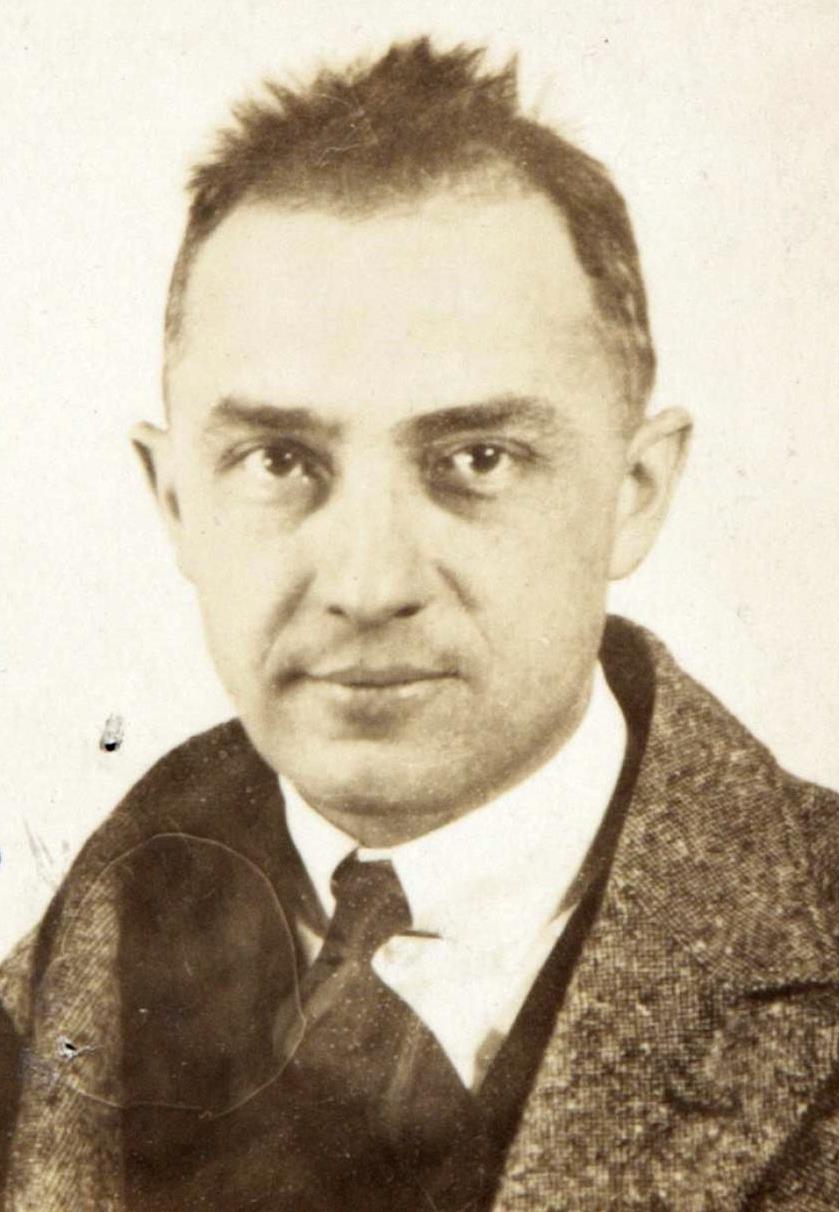
File:William Carlos Williams passport photograph 1921 (cropped).jpg 

The Widow's Lament In Springtime

Sorrow is my own yard

where the new grass 
flames as it has flamed 
often before but not 
with the cold fire 
that closes round me this year. 
Thirtyfive years 
I lived with my husband. 
The plumtree is white today 
with masses of flowers. 
Masses of flowers 
load the cherry branches 
and color some bushes 
yellow and some red 
but the grief in my heart 
is stronger than they 
for though they were my joy 
formerly, today I notice them 
and turn away forgetting. 
Today my son told me 
that in the meadows, 
at the edge of the heavy woods 
in the distance, he saw 
trees of white flowers. 
I feel that I would like 
to go there 
and fall into those flowers 
and sink into the marsh near them.

William Carlos Williams


William Carlos Williams


The Thinker

My wife's new pink slippers 
have gay pompons. 
There is not a spot or a stain 
on their satin toes or their sides. 
All night they lie together 
under her bed's edge. 
Shivering I catch sight of them 
and smile, in the morning. 
Later I watch them 
descending the stair, 
hurrying through the doors 
and round the table, 
moving stiffly 
with a shake of their gay pompons! 
And I talk to them 
in my secret mind 
out of pure happiness.

Barbara Guest

  Santa Fe Trail I go separately The sweet knees of oxen have pressed a path for me ghosts with ingots have burned their bare hands it is th...