Showing posts with label black arts movement. Show all posts

Monday, January 10, 2022

Black Arts movement

 movement was a controversial literary faction that emerged in the mid-1960s as the artistic and aesthetic arm of the Black Power movement, a militant political operation that rejected the integrationist purposes and practices of the Civil Rights movement that preceded it. The Black Arts movement was one of the only American literary movements to merge art with a political agenda. Because poems were short and could be recited at rallies and other political activities to incite and move a crowd, poetry was the most popular literary genre of the Black Arts movement, followed closely by drama. Poet, playwright, activist, and major figure of the Black Arts movement, Amiri baraka (formerly LeRoi Jones) coined the term Black Arts when he established his Black Arts Repertory Theatre/School in New York City's Harlem. Although the Black Arts movement began its decline during the mid-1970s, at the same time as the Black Power movement began its descent, it introduced a new breed of black poets and a new brand of black poetry. It also inspired and energized already established poets like Gwendolyn brooks and Robert hayden. The Black Arts movement created many poetic innovations in form, language, and style that have influenced the work of many of today's spoken word artists and socially conscious rap lyricists.

The poets most often associated with the Black Arts movement include Baraka, Sonia sanchez, Etheridge knight, Nikki GIOVANNI, Larry Neal, Mari Evans, Don L. Lee (now known as Haki MADHUBUTI), Carolyn Rodgers, Marvin X, Jayne cortez, Askia Toure, and June Jordan. A number of important African-American playwrights, fiction writers, and scholars also made significant contributions to the Black Arts movement, creatively as well as philosophically and theoretically, by defining and outlining the objectives and criteria of the movement and its "black aesthetic."

Saturday, December 18, 2021

Gwendolyn Brooks

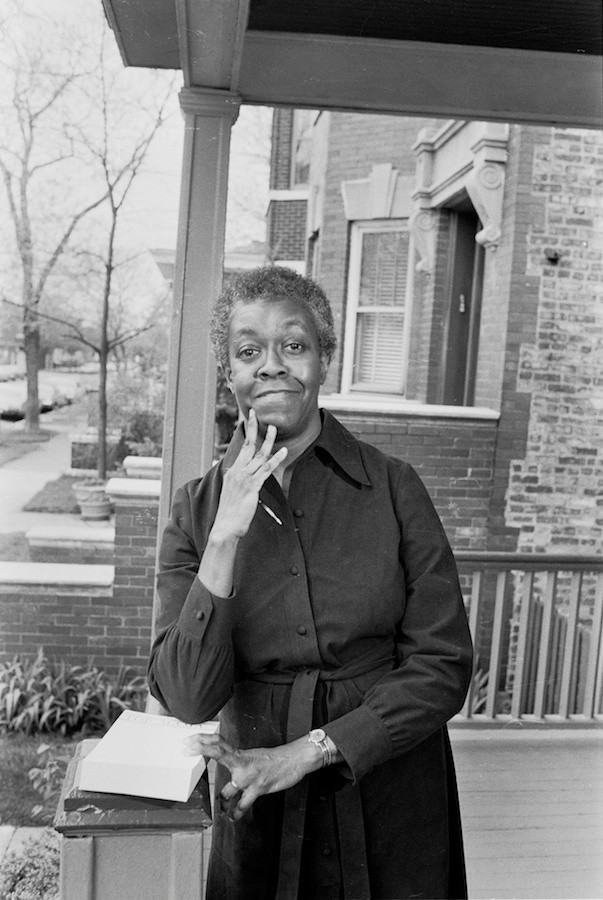
Image by Art Shay


a song in the front yard


I’ve stayed in the front yard all my life.
I want a peek at the back
Where it’s rough and untended and hungry weed grows.   
A girl gets sick of a rose.


I want to go in the back yard now   
And maybe down the alley,
To where the charity children play.   
I want a good time today.


They do some wonderful things.
They have some wonderful fun.
My mother sneers, but I say it’s fine
How they don’t have to go in at quarter to nine.   
My mother, she tells me that Johnnie Mae   
Will grow up to be a bad woman.
That George’ll be taken to Jail soon or late
(On account of last winter he sold our back gate).


But I say it’s fine. Honest, I do.
And I’d like to be a bad woman, too,
And wear the brave stockings of night-black lace   
And strut down the streets with paint on my face.


Friday, December 17, 2021

Gwendolyn Brooks


headshot of Gwendolyn Brooks


Young Afrikans


of the furious


Who take Today and jerk it out of joint   
have made new underpinnings and a Head.   

Blacktime is time for chimeful
poemhood
but they decree a
jagged chiming now.

If there are flowers flowers
must come out to the road. Rowdy!—
knowing where wheels and people are,
knowing where whips and screams are,
knowing where deaths are, where the kind kills are.   

As for that other kind of kindness,
if there is milk it must be mindful.
The milkofhumankindness must be mindful   
as wily wines.
Must be fine fury.
Must be mega, must be main.

Taking Today (to jerk it out of joint)
the hardheroic maim the
leechlike-as-usual who use,
adhere to, carp, and harm.

And they await,
across the Changes and the spiraling dead,   
our Black revival, our Black vinegar,   

our hands, and our hot blood. 

Haki R. Mahdubati


Poet: Whatever Happened to Luther?

he was strange weather, this luther, he read books, mainly 
poetry and sometimes long books about people in foreign 
places. for a young man he was too serious, he never did smile, 
and the family still don’t know if he had good teeth. he liked 
music too, even tried to play the trumpet until he heard the 
young miles davis. he then said that he’d try writing. the family 
didn’t believe him because there ain’t never been no writers in 
this family, and everybody knows that whatever you end up 
doing, it’s gotta be in your blood. it’s like loving women, it’s in 
the blood, arteries and brains. this family don’t even write let-
ters, they call everybody. thats why the phone is off 6 months 
out of a year. then again, his brother willie t. use to write long, 
long letters from prison about the books he was reading by
malcolm x, frantz fanon, george jackson, richard wright and oth-
ers. luther, unlike his brother, didn’t smoke or drink and he’d
always be doing odd jobs to get money. even his closest friends 
clyde and t. bone didn’t fully understand him. while they be par-
tying all weekend, luther would be traveling. he would take his 
little money with a bag full of food, mainly fruit, and a change of
underwear and get on the greyhound bus and go. he said he be 
visiting cities. yet, the real funny thing about luther was his 
ideas. he was always talking about afrika and black people. he 
was into that black stuff and he was light skin as a piece 
of golden corn on the cob. he’d be calling himself black and 
afrikan and upsetting everybody, especially white people. they 
be calling him crazy but not to his face. anyway the family, 
mainly the educated side, just left him alone. they would just be 
polite to him, and every child of god knows that when family
members act polite, that means that they don’t want to be
around you. it didn’t matter much because after his mother died
he left the city and went into the army. the last time we heard 
from him was 1963. he got put out of the army for rioting. he 
disappeared somewhere between mississippi and chicago. a 
third cousin, who family was also polite to, appeared one day
and said that luther had grown a beard, changed his name and 
stopped eating meat. she said that he had been to afrika and 
now lived in chicago doing what he wanted to do, writing books, 
she also said that he smiles a lot and kinda got good teeth.

Haki R. Madhubuti


Rwanda: Where Tears Have No Power


Who has the moral high ground?

Fifteen blocks from the whitehouse
on small corners in northwest, d.c.
boys disguised as me rip each other’s hearts out
with weapons made in china. they fight for territory.

across the planet in a land where civilization was born
the boys of d.c. know nothing about their distant relatives
in Rwanda. they have never heard of the hutu or tutsi people.
their eyes draw blanks at the mention of kigali, byumba
or butare. all they know are the streets of d.c., and do not
cry at funerals anymore. numbers and frequency have a way
of making murder commonplace and not news
unless it spreads outside of our house, block, territory.

modern massacres are intraethnic. bosnia, sri lanka, burundi,
nagorno-karabakh, iraq, laos, angola, liberia, and rwanda are
small foreign names on a map made in europe. when bodies
by the tens of thousands float down a river turning the water
the color of blood, as a quarter of a million people flee barefoot
into tanzania and zaire, somehow we notice. we do not smile,
we have no more tears. we hold our thoughts. In deeply
muted silence looking south and thinking that today
nelson mandela seems much larger
than he is.


Haki R. Madhubuti

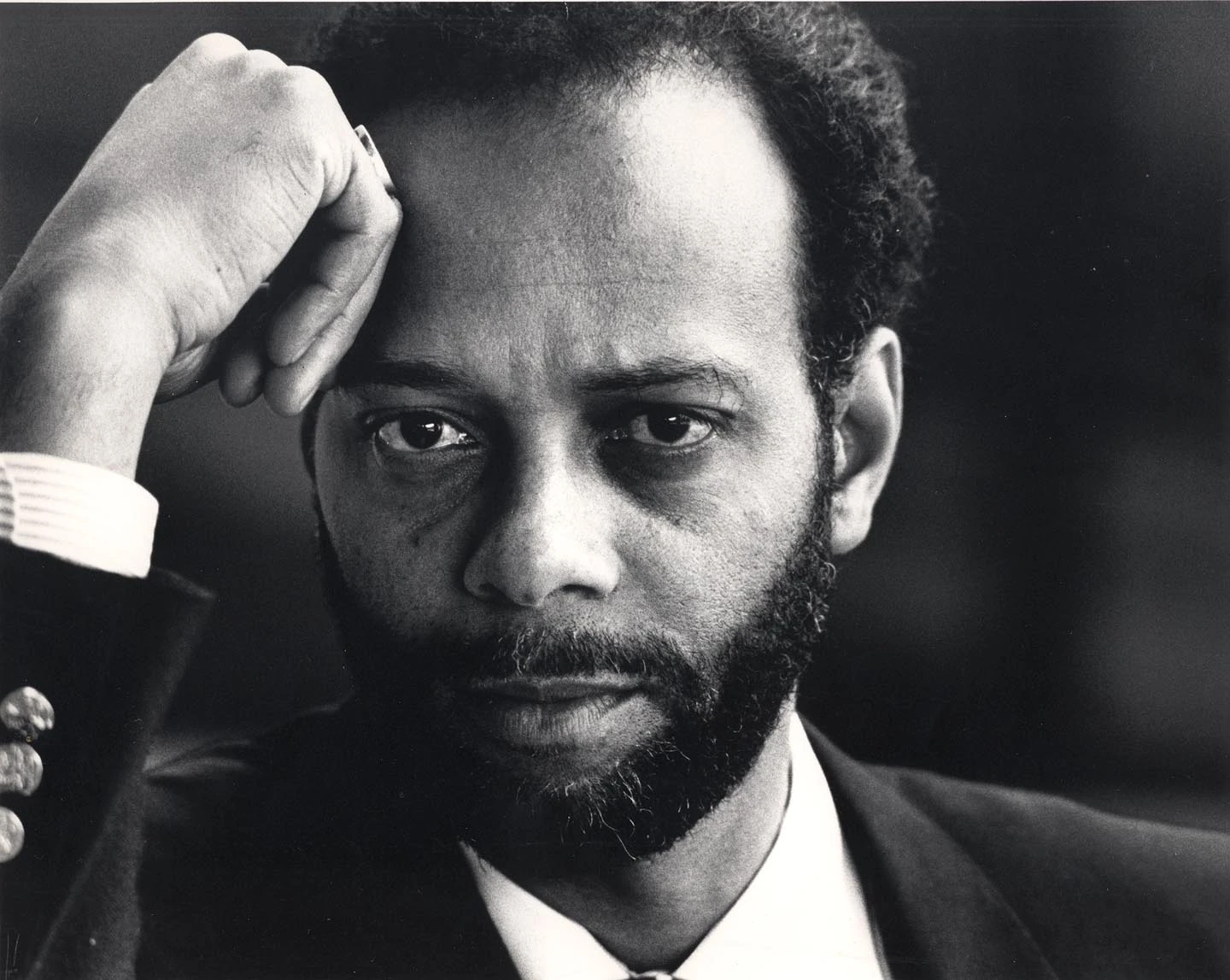
 Haki R. Madhubuti during a newspaper interview in Chicago in the late 1960s.


Quality: Gwendolyn Brooks at 73

June 7, 1990

breath,
life after seven decades plus three years
is a lot of breathing. seventy three years on this
earth is a lot of taking in and giving out, is a
life of coming from somewhere and for many a bunch
of going nowhere.

how do we celebrate a poet who has created
music with words for over fifty years, who has
showered magic on her people, who has redefined
poetry into a black world exactness
thereby giving the universe an insight into
darkroads?

just say she interprets beauty and wants to
give life, say she is patient with phoniness
and doesn’t mind people calling her gwen or sister.
say she sees the genius in our children, is visionary
about possibilities, sees as clearly as ray charles and
stevie wonder, hears like determined elephants looking
for food. say that her touch is fine wood, her memory
is like an african roadmap detailing adventure and
clarity, yet returning to chicago’s south evans
to record the journey. say her voice is majestic
and magnetic as she speaks in poetry, rhythms, song
and spirited trumpets, say she is dark skinned,
melanin rich, small-boned, hurricane-willed,
with a mind like a tornado redefining the landscape.

life after seven decades plus three years
is a lot of breathing.
gwendolyn, gwen, sister g has
not disappointed our expectations.
in the middle
of her eldership she brings us
vigorous language, memory,
illumination.

she brings breath.


Barbara Guest

  Santa Fe Trail I go separately The sweet knees of oxen have pressed a path for me ghosts with ingots have burned their bare hands it is th...