Dick Higgins, "New Song in an Old Style" (1967)
(check one)

		__ speak

		__ dance
When I
		__ fall in love

		__ grow old


	(check one)

			__ I'm going to be

			__ it'll be with


			(check one)

				__ an apple.

				__ a lover.

				__ a smile.

				__ you.
Dick Higgins, "New Song in an Old Style" (1967)
(check one) __ speak __ dance When I __ fall in love __ grow old (check one) __ I'm going to be __ it'll be with (check one) __ an apple. __ a lover. __ a smile. __ you.

She said: “Some bath rub they are people”
dish soprano
wins ovation
in “Met.”
By John Mo” ” ” ”
one of the MOST in opera
tan opera
her hus
dish, , , ,
had not
good the
after and
to some opposed
in wait
with Portugal
tied Spain into
a government – – – –
Plan to broaden
the killers
tomorrow &&&
the Federal government
were taken. .
years years
needed because
She said: “Some bath rub they are people”
Cut up Paris Herald Tribune articles

“I have the documents. Documents, proof, evidence, photograph, signature. One day you raise your right hand and you are American. They give you an American Pass port. The United States of America. Somewhere someone has taken my identity and replaced it with their photograph. The other one. Their signature their seals. Their own image. And you learn the executive branch the legislative branch and the third. Justice. Judicial branch. It makes the difference The rest is past.”
excerpt― Dictee

Excerpt from Dictee
From A Far
What nationality
or what kindred and relation
what blood relation
what blood ties of blood
what ancestry
what race generation
what house clan tribe stock strain
what lineage extraction
what breed sect gender denomination caste
what stray ejection misplaced
Tertium Quid neither one thing nor the other
Tombe des nues de naturalized
what transplant to dispel upon

photograph by Jonathan Williams
Lately alerted to Ronald Johnson’s “Six, Alas!”—a circa 1990 Chicago Review-published “toast to six women writers, hardly unknown but alike disregarded at present by fashion”—with its deftly considered applaudissements. For Edith Sitwell (“in England I was prepared for many an incomprehension, but the blank wall set up against Edith I always wanted to leap over and set up a ruckus of quotation”), Edna St. Vincent Millay (“No other poet I recall has been so acclaimed then so eclipsed. Within a decade Eliot had made her old hat”), Louise Bogan (Johnson quotes Bogan’s clipped and pertinent verdict regarding “the practice of lyric poetry”: “The chances of getting away with pure fakery within it are very small. One cannot fib—it shows, one cannot manipulate—it spoils. One cannot apply decoration from the outside; or pretend that non-feeling is feeling; or indulge in any of the lower-grade emotions, such as self-pity”), Stevie Smith (“As to technique, she was as unselfconscious as Blake about jarring sense into song. For those who never heard her, the poems can seem ungainly on the page, though when she read aloud they could stick in the ear like Tin Pan Alley”), and Lorine Niedecker (“We admired each other’s poems, though we never met. Shy, she liked it that way, for most attention, other than letters, made her too self-conscious and awkward, she was so unused to it. She’s likened by her readers to Emily Dickinson, not only for this, but for her plain wry dignity with every word.”) The sixth “alas”—Johnson’s opening is a remarkable paean to the way we lose things, alas—some unjustly, others not so—and the need for looking, and selecting:
We all like to believe, as readers, the sands of time might part to show landmark authors, shining a new horizon. It is part of our myth that straw for the bricks of Modernism might be threshed from things like Pound’s exasperation with Sordello, his fascination with Provençal poets’ reiteration of sounds, from Eliot refurbishing Donne for the pantheon, and the unwrapping of fragments of pure Sappho, forgotten, from minor Egyptian mummies. Though every time has its winds—in truth there is not an Ozimandias under every dune.
The sixth “alas” is Elizabeth Bowen, allowing Johnson both to quote the terrific opening to Death of the Heart (“That morning's ice, no more than a brittle film, had cracked and was now floating in segments. These tapped together or, parting, left channels of dark water, down which swans in slow indignation swam”—Johnson’s remark: “Indelible, that “down which swans in slow indignation swam”—a frieze with all the swans’ neck s’s held in rhythm’s sway”—critical sentence-ry mimicking what it addresses) and to defend the capacity of prose, too, to “make the stone stoney” (Shklovsky). Johnson:
Our first read-through of Shakespeare makes any defined border between poetry and prose a quicksand. Later, we might make the distinction that whereas poetry is always visible, like stepping stones on a page, prose is more like water you swim through. First from Flaubert and Joyce, then Henry James, I began to see prose might be also word by word, and phrase after phrase, actually physically enjoyable as poetry, something to read and re-read for itself. And that this might include many before and in between Sir Thomas Browne and Elizabeth Bowen.
One begins to comprehend how Johnson’s own work ranges so effortlessly along genres, visual poetry’s distinct markers to “watery” prose poems. And, noting the humble incisings of Johnson’s criticism, the deft grace of its modesty—oughtn’t “the age” have demanded more of it?
Peter O'Leary (excerpt)

Photograph by Ralph Eugene Meatyard
from Letters to Walt Whitman

David Doyle & David Melnick
Men in Aida, a three-part project of which only the first volume has appeared in book form (Tuumba, 1983), is a homophonic translation of The Iliad, but with a difference. Where Zukofsky’s Catullus, the mother of this genre of miming the sound of an alien text, aims at capturing also the basic spirit, if not always the figurative and narrative frames, of its source material, Men finds a radically new tale in Homer’s phonemes. Thus
Men in Aida’s opening stanza —
Men in Aida, they appeal, eh? A day, O Achilles! Allow men in, emery Achaians. All gay ethic, eh? Paul asked if tea mousse suck, as Aida, pro, yaps in. Here on a Tuesday. ‘Hell,’ Rhea to cake Eunice in. ‘Hojo’ noisy tap as hideous debt to lay at a bully.
Ex you, day. Tap wrote a ‘D,’ a stay. Tenor is Sunday. Atreides stain axe and Ron and ideas ’ll kill you.
— is rendered more literally by Michael Reck as:
Sing, Goddess, Achilles’ maniac rage:
ruinous thing! it roused a thousand sorrows and hurled many souls of mighty warriors
to Hades, made their bodies food for dogs
and carrion birds — as Zeus’s will foredoomed— from the time relentless strife came between Atreus’ son, a king, and brave Achilles.
Reck attempts to convey the taut warp of Homer’s line by shortening it in English. Melnick’s version careens from syllable to syllable, capturing the dance of the phonemes with remarkable exactness — to hear Melnick read the work aloud is an unforgettable experience – but with virtually no interest in the “story” as such. Instead, themes emerge from the syllabic stream that very quickly make apparent that Men is, in the most literal sense, a ludic gay utopia:
Ought a Paw tempt ya? Air rib bowl. Lucky beau tea a nay Rae. Cartoned ale lay. Sand tape a.m. Allah, Paul, a Metaxa.
Urea Tess key you into the lass at ache ace saw.
All as oil mega-night days am is poem math. Offer a suck. I raise. Team men are new men. Noe Menelaus sort o’ coo. No! Pa! Prose Trojans. Toe nudie met a tray. Pee owed a leg is ace.
Guy dame! Oy gay Roz out owes a fairy say thigh a pay lays.
O ape pee Paula Moe gay sad do sand dame I who yes a guy own. Ooh men soy pot, eh? Is son echo gay?
Napoleonette
I had a bit part in Napoleonette. I wrapped some meat in newsprint and handed
it to a woman. The scene was shot in a moment. Since I am no B-movie
aficionado, I went home, and in the late afternoon the phone rang me from my
sleep. Putain was angry, he said, "All it was was the lady reaching over the
counter-for nothing!-you wasn't even there."
Sometimes a ghost entered my heart and I could feel, and sometimes a phrase
entered my mind and I could speak, with reason. But never was I able to stay a
man long enough to remain him.
DESIGNED, EDITED, AND PRODUCED by Dick Higgins, the Something Else Press books contained offbeat and avant-garde writing in a neat and tidy, yet quirky and distinctive form. The press began in 1964 following Higgins’s break with Fluxus founder George Maciunas and embodied many of the concerns of the then nascent art movement. Early titles included Jefferson’s Birthday/Postface, Higgins’s collection of performance scores; mail art pioneer Ray Johnson’s The Paper Snake, Al Hansen’s A Primer of Happenings & Time/Space Art, and Romanian-born Nouveau réaliste artist Daniel Spoerri’s An Anecdoted Topography of Chance. Higgins’s foew&ombwhnw (a 1969 collection disguised as a prayer book) contains his important essay “Intermedia,” in which he describes artworks which “fall between media,” arguing that the social conditions of the time (early to mid-1960s) no longer allowed for a “compartmentalized approach” to either art or life.
![Wolf Vostell, and Dick Higgins, eds. Fantastic Architecture [1970 or 1971]. Book jacket illustration: Richard Hamilton’s Guggenheim Collage, 1967.](https://fromasecretlocation.com/wp-content/uploads/2016/09/Vostell-architecture-r-360x498.jpg)
Wolf Vostell and Dick Higgins, eds., Fantastic Architecture [1970 or 1971]. Book jacket illustration is Richard Hamilton’s Guggenheim Collage, 1967.
“My job included copy editing, proofreading, managing the office and correspondence. I never knew what to expect, as Dick was always bursting with ideas…. My most vivid editorial memory concerns…Daniel Spoerri’s An Anecdoted Topography of Chance, translated from the French and anecdotally expanded by the author’s friend, the expatriate American poet/artist Emmett Williams. (Emmett, though still in Europe at the time, later came to New York to follow me as editor at the Press.) Due to Emmett’s professionalism, the Topography made for tricky proofreading. Unaware of Emmett and Dieter Roth’s mnemonic ‘the man with 5 A’s in his name,’ I removed what appeared to be extra letters from the name Aagaard Andersen. As the proofs traveled back and forth across the ocean in those pre-fax days, Emmett kept putting the A’s back in and I conscientiously kept removing them. I got my comeuppance on that one when about 12 or 15 years later, I was shackled with a typewriter that printed double A’s every time I hit the key.”
— Barbara Moore, from Some Things Else About Something Else(New York: Granary Books, 1991)
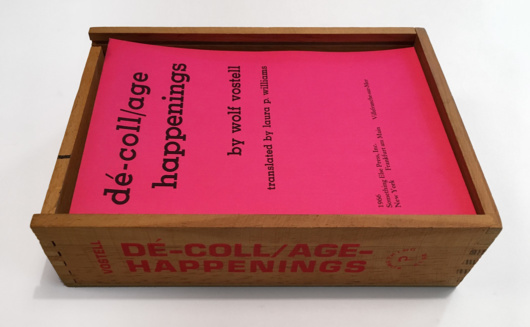
Wolf Vostell, dé-coll/age happenings (1966). Translated by Laura P. Miller. Wooden box with sliding plexiglass panel as cover. Contents include book plus 15 folded posters, silk-screen print, one package of Bromo-Seltzer mounted on mirrored Mylar, and one piece of matzoh.
Something Else Press books include
Cage, John. Diary: How to Improve the World (You Will Only Make Matters Worse) Continued Part Three. 1967. A Great Bear Pamphlet.
Cage, John, with Alison Knowles. Notations. 1969.
Cowell, Henry. New Musical Resources. 1969.
Cunningham, Merce. Changes: Notes on Choreography. 1968.
Filliou, Robert. Ample Food for Stupid Thought. 1965.
Finlay, Ian Hamilton, and Gordon Hundy. A Sailor’s Calendar. 1971.
Gomringer, Eugen. The Book of Hours and Constellations. 1968. Translated and edited by Jerome Rothenberg.
Gysin, Brion. Brion Gysin Let the Mice In. 1973. Edited by Jan Herman with contributions by William S. Burroughs and Ian Sommerville.
Hansen, Al. A Primer of Happenings & Time/Space Art. 1965.
Higgins, Dick. foew&ombwhnw. 1969.
Higgins, Dick. Jefferson’s Birthday/Postface. 1964.
Johnson, Ray. The Paper Snake. 1965.
Kaprow, Allan. Some Recent Happenings. 1966. A Great Bear Pamphlet.
Knowles, Alison, Tomas Schmit, Benjamin Patterson, and Philip Corner. The Four Suits. 1965.
McLuhan, Marshall. Verbi-Voco-Visual Explorations. 1967.
Oldenburg, Claes. Store Days. 1967.
Porter, Bern. I’ve Left: A Manifesto and a Testament of SCIence and -ART (SCIART). 1971.
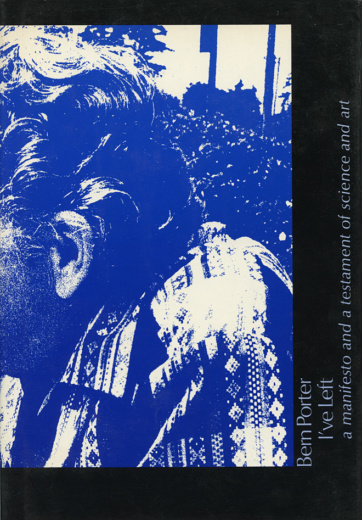
Bern Porter, I’ve Left: A Manifesto and a Testament of SCIence and -ART (SCIART)(1971).
Roth, Dieter. 246 Little Clouds. 1968. Introduction by Emmett Williams.
Spoerri, Daniel. An Anecdoted Topography of Chance. 1966. Translated from the French, and further anecdoted at random by Emmett Williams. With one hundred reflective illustrations by Topor.
Stein, Gertrude. The Making of Americans. 1966.
Vostell, Wolf. dé-coll/age happenings. 1966. Translated by Laura P. Miller.
Vostell, Wolf, and Dick Higgins, eds. Fantastic Architecture. 1971.
Williams, Emmett. Anthology of Concrete Poetry. 1967.
Williams, Emmett. Sweethearts. 1967.
Resource
For a complete list of Something Else publications, the reader is referred to: Peter Frank, Something Else Press: An Annotated Bibliography (New Paltz, NY: Documentext/McPherson & Company, 1983).

ON ONE WORD POEMS
At first glance this one-word poem appears disorienting; it takes a second for our eyes to adjust to it. Perhaps it’s because as viewers the extra y and e skew our perception a little. So we find ourselves scanning the word back and forth as if in a REM (Rapid Eye Movement) state. But what makes this poem effective too is its play on a palindrome. A palindrome is a word or sentence that reads the same forward and backward. Some examples are “toot,” “minim,” “never odd or even,” or “draw o coward.” In his one-word poem, Saroyan gets us to understand his interaction with language. His use of a palindrome gets us, as readers, to look closely at language, to literally eye the word, but then he adds those extra letters and suddenly the poem becomes visible as an image. In Ian Daly’s essay, “You Call That Poetry?!” Saroyan says, “I got intrigued by the look of individual words; the word ‘guarantee,’ for instance, looks to me a bit like a South American insect.” The one-word poemgets us to think about the word as picture and reminds us, as poets, that to develop the mind’s eye we must open ourselves up to seeing language and to feel the energy of a letter. The origin of the A, for example, derives from a pictogram dating back to the 11th century in the Middle East. The A is an ox-head, and if you rotate it until its stems point upward you will see the ox’s muzzle in the area between the apex and crossbar. Once we are aware that the letter is a picture, it’s up to us, as writers, to imagine the ox ploughing the field of the page, getting it ready for us to plant and expand our imagination.
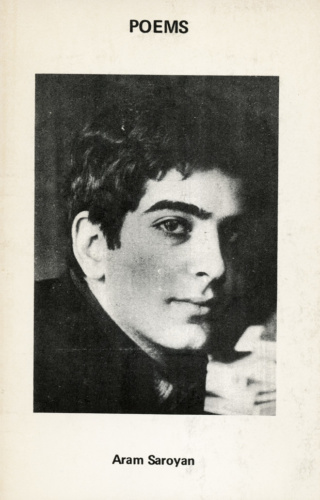
Aram Saroyan, Poems (1972). Cover photograph by Gailyn Saroyan.
"Would you mind
If I headed up early?"
Says the husband
To his young wife.
"Follow when you like."
Later that evening
The beautiful face
And exquisite limbs
Will rise from the table
Of the Southern inn
Having been spied
By the antihero
Across the room
Reading an indifferent book.
Oh, quick —
Let a storm kill the light!
But you might as well say it
To a wall.
We can't change
A single
Silver setting, or
Even by one day
Reduce
The bright full moon.
The clock in literature
Holds that moon.
"I know I can't say
A single thing to stop you,"
Says the old man at table
To the suddenly risen girl.
"But sleep on it, will you?"
Not now —
Not ever.
The clock in literature
Holds the ancient rune.
"I wonder if I might
Have a word with you,"
Says the antihero
To the lissome
Dark-eyed angel.
for Diane Ward
Santa Fe Trail I go separately The sweet knees of oxen have pressed a path for me ghosts with ingots have burned their bare hands it is th...


