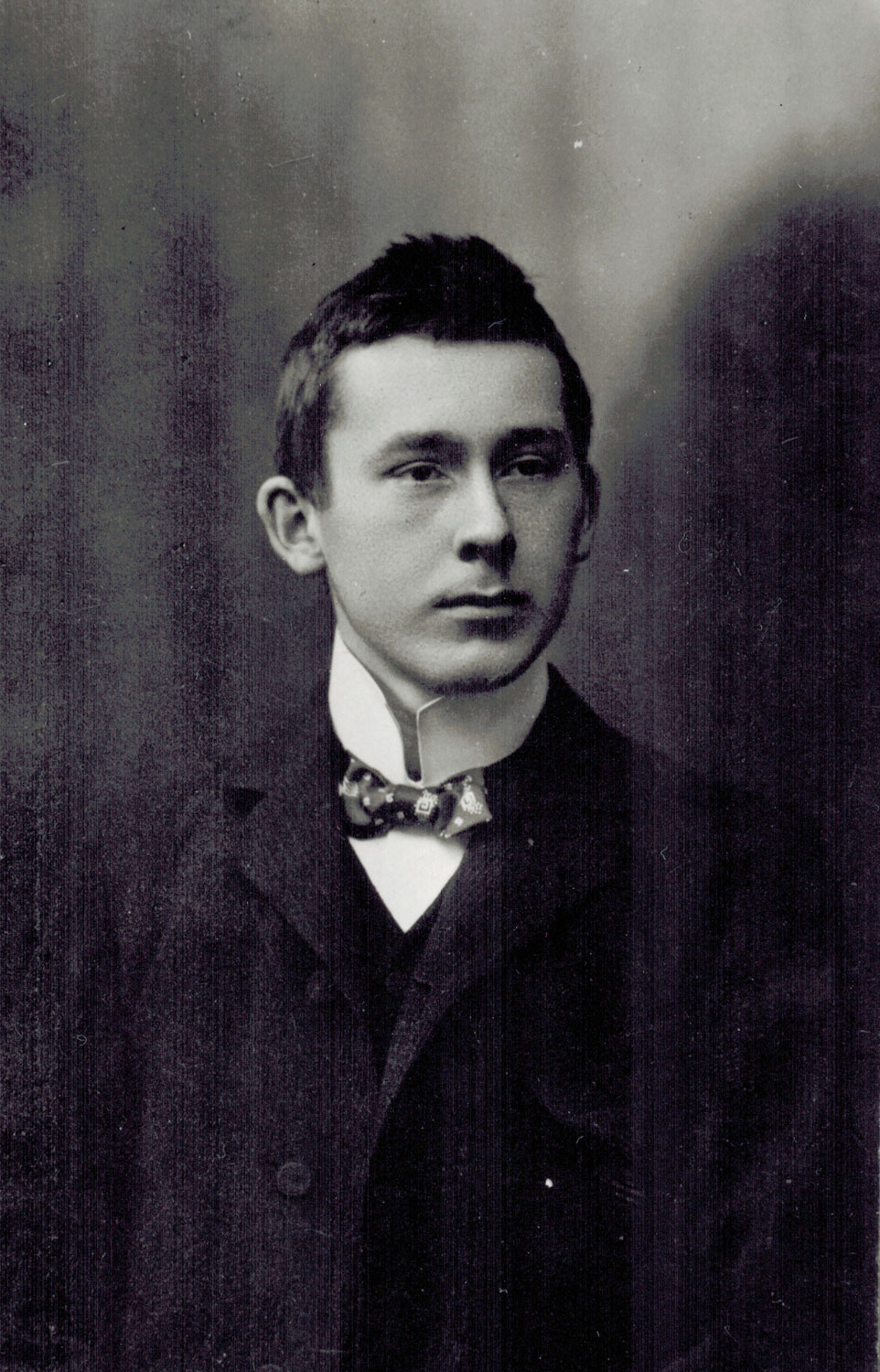
Kp'erioum, Raoul Hausmann (1886-1971)
The optophonetic of poet Raoul Hausmann, presented by Cecile Bargues
« Sometimes an invention is created more than once », wrote Raoul Hausmann in the Courrier Dada. Regarded as being one of the brightest stars of Dada Berlin, nothing was filtered prior to being expressed, says Hausmann, from those magical moments at Cabaret Voltaire nightclub in Zurich when Hugo Ball appeared on stage dressed as a « magical bishop » and recited « abstract chants » (« gadji beri bimba ») and relived « the sounds of very ancient sacerdotal laments ». In 1918 Hausmann also declaimed « letter poems » that involved the whole body via variations of breath and voice in order to be expressed, without knowing that this wordless poetry already constituted one of the most salient features of Dada. Even if he never knew Hugo Ball, communication being difficult (Berlin experiencing the Spatacist uprising at the time) Hausmann could only agree with the concept of freeing himself from a language that « had become unworkable», because it had been « ravaged by journalism.» But that’s where any complicity ended. The radical Hausmann was a million miles from any praying as he stripped language down to its barest bones, that’s to say right down to the letters themselves. Letters were his « new material »; the building blocks of his optophonetic poetry. « Optophonetics » (the science of visible speech sounds) was the term used to coin the fusion of the visual with sound; in other words, the concept that characterised him. An example of this can be found in Kp’erioum, where font size and bold type indicate vocal amplitude. Raoul Hausmann « revealed the surprise and joy of Dada dancing with typography », wrote Brion Gysin, the inventor of the cut-up collage technique (‘cut’ in the language of the media) in collaboration with William Burroughs, and the Dreamachine (a flicker device) with Ian Sommerville. We are also indebted to Hausmann for the optophone, a machine capable of transforming sound into coloured lights and vice versa. He applied for a patent for this with an engineer called Daniel Broïdo but it did not, strictly speaking, come to fruition. Perhaps one might argue that this legendary optophone is our most efficient dream machine.
Art historian, Cecile Bargues is a Dada and Raoul Hausmann specialist
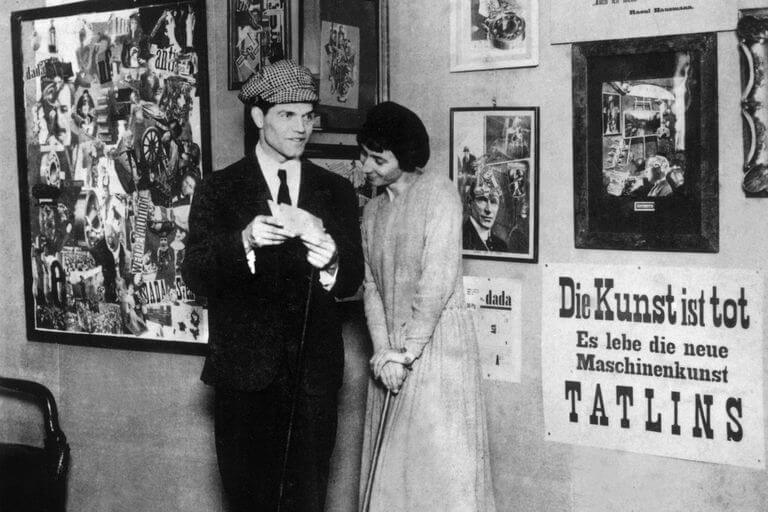
Raoul Hausmann and Hannah Hoch, 1st International Dada Convention (Berlin, 1920)
On the 1st of February 1971, Austrian artist and writer, Raoul Hausmann, died in Limoges, France. He was one of the founders of Berlin Dada. Together with Richard Huelsenbeck, George Grosz, John Heartfield, Fritz Jung, Hannah Höch, Walter Mehring and Johannes Baader, he established the famous Club Dada, where all kinds of evening events, poetry performances, and lectures took place. The first staged event, on the 12th of April 1918, with Huelsenbeck’s reading of the Dada manifesto – “Dadaism in Life and in Art,” followed by the Cubist dance performed by George Grosz, ended with Hausmann’s lecture – “The New Materials in Painting”, which investigated man’s “sexopsychic capacity” in art and explored the art of real objects. The lecture, as well as all the other performances of the night, caused a great stir among the public; this is how Hausmann described the atmosphere during the event: “My text, “The New Materials in Painting,” created such a commotion that the management, who was worried about its paintings displayed on the walls, switched of the lights in the middle of my speech, condemning me to darkness and silence.” (Raoul Hausmann, Am Anfang War Dada, 1972).
 |

The cows sit on the telegraph poles and play chess
The cockatoo under the skirts of the Spanish dancer
Sings as sadly as a headquaters bugler and the cannon lament all day
That is the lavender landscape Herr Mayer was talking about
when he lost his eye
Only the fire department can drive the nightmare from the drawing-
room bur all the hoses are broken
Ah yes Sonya they all take the celluloid doll for a changeling
and shout: God save the King
The whole Monist Club is gathered on the steamship Meyerbeer
But only the pilot has any conception of high C
I pull the anatomical atlas out of my toe
a serious study begins
Have you seen the fish that have been standing in front of the
opera in cutaways
for the last two days and nights...?
Ah ah ye great devils - ah ah ye keepers of bees and commandments
With a bow wow wow with a bow woe woe who does today not know
what our Father Homer wrote
I hold peace and war in my toga but I'll take a cherry flip
Today nobody knows whether he was tomorrow
They beat time with a coffin lid
If somebody had the nerve to rip the tail feathers
out of the trolley car it's a great age
The professors of zoology gather in the medows
With the palms of their hands they turn back the rainbows
the great magician sats the tomatoes on his forehead
Again thou hauntest castle and grounds
The roebuck whistles the stallion bounds
(And this is how the world is this is all that's ahead of us).


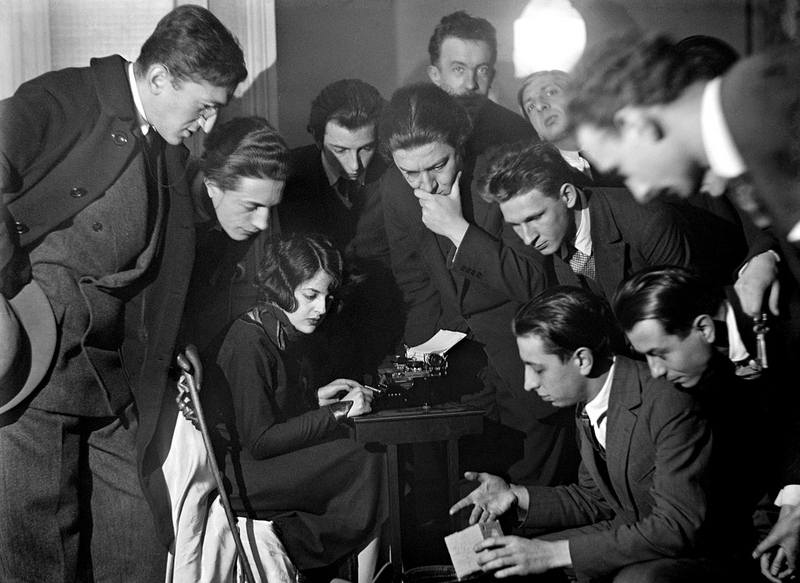
Back row: Louis Aragon, Theodore Fraenkel, Paul Eluard, Emmanuel Faÿ (brother of Bernard Faÿ).
Second row: Paul Dermée, Philippe Soupault, Georges Ribemont-Dessaignes.
Front row: Tristan Tzara (with monocle), Celine Arnauld, Francis Picabia, André Breton.

Man Ray’s photograph of the Dadaists taken in 1922. Back row from left: Paul Chadourne, Tristan Tzara, Philippe Soupault, Serge Charchoune; front row from left: Paul Éluard, Jacques Rigaut, Marie-Louise Soupault, Georges Ribemont-Dessaignes.
House under construction with dried branches, like spiders, in your scaffolding
Rise to skies with serenity
Until the clouds will have served as curtains
And the stars: relief for lamps on balconies in the evening.
Between two chestnut trees burdened like discharged patients
Grew the Jewish cemetery - out of boulders;
On the outskirts of town, on a hill,
Crawl graves like worms.
The yellow dogcart waits for us at the train station
In me reeds get torn with a paper rustle
I'd like to come to an end slowly all across the country
And that my soul would hesitate like a dancer on a string.
Roaming the woods are
Gypsy beggars with ashen beards
That you're afraid to meet
When the sun rubs its eyelid on paths.
On horseback we'll travel day after day
We'll stop at grey inns,
Where one makes many friends
And sleeps at night with the innkeeper's daughter.
Under the walnut trees--where the wind passes by, heavy like a garden of wells,
We'll play chess
Like two old pharmacists
And my sister will read the newspapers in a hammock
We'll undress naked on the hill
To scandalize the priest, to please the girls,
We'll walk like peasants with large straw hats
We'll bathe near the mill wheel
We'll lay in the sun without coyness
And they'll steal our clothes and the dogs will bark at us...
1915
translated from the Romanian by Victor Pambuccian
Gadji beri bimba
gadji beri bimba glandridi laula lonni cadori
gadjama gramma berida bimbala glandri galassassa laulitalomini
gadji beri bin blassa glassala laula lonni cadorsu sassala bim
gadjama tuffm i zimzalla binban gligla wowolimai bin beri ban
o katalominai rhinozerossola hopsamen laulitalomini hoooo
gadjama rhinozerossola hopsamen
bluku terullala blaulala loooo
zimzim urullala zimzim urullala zimzim zanzibar zimzalla zam
elifantolim brussala bulomen brussala bulomen tromtata
velo da bang band affalo purzamai affalo purzamai lengado tor
gadjama bimbalo glandridi glassala zingtata pimpalo ögrögöööö
viola laxato viola zimbrabim viola uli paluji malooo
tuffm im zimbrabim negramai bumbalo negramai bumbalo tuffm i zim
gadjama bimbala oo beri gadjama gaga di gadjama affalo pinx
gaga di bumbalo bumbalo gadjamen
gaga di bling blong
gaga blung
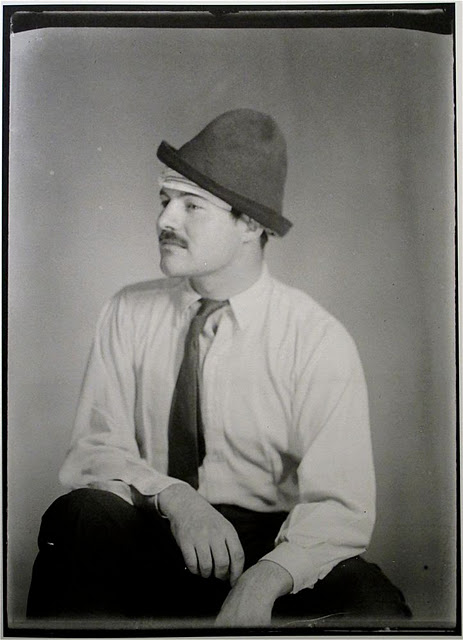
"Later he had seen the things he could never think of and later still he had seen much worse. So when he got back to Paris that time he could not talk about it or stand to have it mentioned. And there in the café as he passed was that American poet with a pile of saucers in front of him and a stupid look on his potato face talking about the Dada movement with a Roumanian who said his name was Tristan Tzara, who always wore a monocle and had a headache..."

The Gas Heart was first staged in Paris, as part of the 1921 "Dada Salon" at the Galerie Montaigne.
The play's second staging, as part of the 1923 show Le Coeur à barbe (The Bearded Heart) and connected to an art manifesto of the same name as the latter, featured characteristic costumes designed by Sonia Delaunay. The show coincided with a major split in the avant-garde movement, which, in 1924, led Tzara's rivals to establish Surrealism. Opposing his principles to the dissident wing of Dada, represented by André Breton and Francis Picabia, Tzara rallied around him a group of modernist intellectuals, who endorsed his art manifesto. The conflict between Tzara and Breton culminated in a riot, which took place during the premiere of The Gas Heart.
Santa Fe Trail I go separately The sweet knees of oxen have pressed a path for me ghosts with ingots have burned their bare hands it is th...