Showing posts with label ny school. Show all posts

Wednesday, March 2, 2022

Barbara Guest


001guest

Santa Fe Trail

I go separately
The sweet knees of oxen have pressed a path for me
ghosts with ingots have burned their bare hands
it is the dungaree darkness with China stitched
where the westerly winds
and the traveler’s checks
the evensong of salesmen
the glistening paraphernalia of twin suitcases
where no one speaks English.
I go separately
It is the wind, the rubber wind
when we brush our teeth in the way station
a climate to beard. What forks these roads?
Who clammers o’er the twain?
What murmurs and rustles in the distance
in the white branches where the light is whipped
piercing at the crossing as into the dunes we simmer
and toss ourselves awhile the motor pants like a forest
where owls from their bandaged eyes send messages
to the Indian couple. Peaks have you heard?
I go separately
We have reached the arithmetics, are partially quenched
while it growls and hints in the lost trapper’s voice
She is coming toward us like a session of pines
in the wild wooden air where rabbits are frozen,
O mother of lakes and glaciers, save us gamblers
whose wagon is perilously rapt.

Barbara Guest


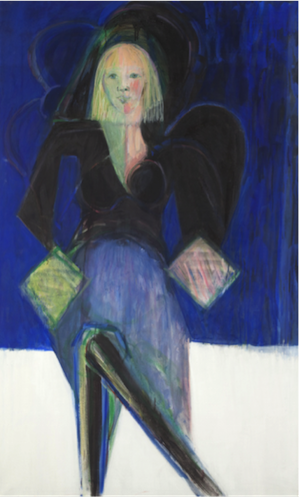
Fay Lansner: “Portrait of Barbara Guest” (1970s. Oil on canvas, 60 x 36 in.).

                                                Fay Lasner. portrait of Barbara Guest, 1970

Non Est . . .


Nothing more to say, Catullus,
            you have walked away

                                   from the green room
                                      "       "     dark room
You have turned your head
                                   from the clam beds

                                            Catullus!

You must be hiding!

                                   I do not know the address
                                   of your villa
I do not know the fiddlers, the caterers
                                   or those space girls
who sang of those women
(now they’re wringing their hands)

I am a visitor who reads magazines
                                   in one language

Sunday, February 27, 2022

John Ashbery on Gertrude Steib


Perhaps the word that occurs oftenest in the Stanzas is the word "they," for this is a poem about the world, about "them." (What a pleasant change from the eternal "we" with which so many modern poets automatically begin each sentence, and which gives the impression that the author is sharing his every sensation with some invisible Kim Novak.) Less frequently, "I" enters to assess the activities of "them," to pick up after them, to assert his own altered importance. As we get deeper into the poem, it seems not so much as if we were reading as living a rather long period of our lives with a houseful of people. Like people, Miss Stein's lines are comforting or annoying or brilliant or tedious. Like people, they sometimes make no sense and sometimes make perfect sense; or they stop short in the middle of a sentence and wander away, leaving us alone for awhile in the physical world, that collection of thoughts, flowers, weather, and proper names. And, just as with people, there is no real escape from them: one feels that if one were to close the book one would shortly re-encounter the Stanzas in life, under another guise. As the author says, "It is easily eaten hot and lukewarm and cold / But not without it."

Stanzas in Meditation gives one the feeling of time passing, of things happening, of a "plot," though it would be difficult to say precisely what is going on. Sometimes the story has the logic of a dream:

She asked could I be taught to be allowed
And I said yes oh yes I had forgotten him
And she said does any or do any change
And if not I said whom could they count.

while at other times it becomes startlingly clear for a moment, as though a change in the wind had suddenly enabled us to hear a conversation that was taking place some distance away:

He came early in the morning.
He thought they needed comfort
Which they did
And he gave them an assurance
That it would be all as well
As indeed were it
Not to have it needed at any time

But it is usually not events which interest Miss Stein, rather it is their "way of happening," and the story of Stanzas in Meditation is a general, all-purpose model which each reader can adapt to fit his own set of particulars. The poem is a hymn to possibility; a celebration of the fact that the world exists, that things can happen.

In its profound originality, its original profundity, this poem that is always threatening to become a novel reminds us of the late novels of James, especially The Golden Bowl and The Sacred Fount, which seem to strain with a superhuman force toward "the condition of music," of poetry. In such a passage as the following, for instance:

Be not only without in any of their sense
Careful
Or should they grow careless with remonstrance
Or be careful just as easily not at all
As when they felt.
They could or would would they grow always
By which not only as more as they like.
They cannot please conceal
Nor need they find they need a wish

we are not far from Charlotte's and the Prince's rationalizations. Both Stanzas in Meditation and The Golden Bowl are ambitious attempts to transmit a completely new picture of reality, of that real reality of the poet which Antonin Artaud called "une realite dangereuse et typique." If these works are highly complex and, for some, unreadable, it is not only because of the complicatedness of life, the subject, but also because they actually imitate its rhythm, its way of happening, in an attempt to draw our attention to another aspect of its true nature. Just as life is being constantly altered by each breath one draws, just as each second of life seems to alter the whole of what has gone before, so the endless process of elaboration which gives the work of these two writers a texture of bewildering luxuriance -- that of a tropical rain-forest of ideas -- seems to obey some rhythmic impulse at the heart of all happening.

In addition, the almost physical pain with which we strive to accompany the evolving thought of one of James's or Gertrude Stein's characters is perhaps a counterpart of the painful continual projection of the individual into life. As in life, perseverance has its rewards -- moments when we emerge suddenly on a high plateau with a view of the whole distance we have come. In Miss Stein's work the sudden inrush of clarity is likely to be an aesthetic experience, but (and this seems to be another of her "points") the description of that experience applies also to "real-life" situations, the aesthetic problem being a microcosm of all human problems.

I should think it makes no difference
That so few people are me.
That is to say in each generation there are so few geniuses

And why should I be one which I am
This is one way of saying how do you do
There is this difference
I forgive you everything and there is nothing to forgive.

It is for moments like this that one perseveres in this difficult poem, moments which would be less beautiful and meaningful if the rest did not exist, for we have fought side by side with the author in her struggle to achieve them.

Thursday, February 3, 2022

John Ashbery's letters

From Mark Ford's article "Letters/And So it goes/Letters from Young Mr Grace. PN Review 239 (January-February 2018)


The names he used to sign his letters convey a similar breadth of interests: Throckmorton P. Gildersleeve (from an American radio sitcom of the forties and fifties); Mrs Harold Chillywater (from Ronald Firbank); Oriane de Guermantes; Boob McNutt (a 1930s comic strip character); Fleda Vetch (heroine of Henry James’s The Spoils of Poynton); Sybil Fawlty; Pastor Fido (from an opera by Handel); The Countess Gruffanuff (from a Thackeray fairytale); Wackford Squeers and Mrs Fezziwig and Miss Havisham; Miss Turnstiles (from the 1949 movie On the Town); Dagwood Bumstead (from the comic strip Blondie); Diggory Venn (from Thomas Hardy’s The Return of the Native); Adinolfa, Carmichael, Bob Boucharessas (from Roussel’s Impressions d’Afrique); Marjory Frobisher (from To the Manor Born); The Sea Hag (from Popeye); Puzzled in Pomona; Captain Peacock, Mr Grainger, Cuthbert Rumbold and Young Mr Grace (from Are You Being Served?). 

Like these characters, John seemed indestructible. I am still finding it hard to believe I have no more of his witty, elegant, erudite, goofy, gossipy, supremely entertaining letters to look forward to – and then to answer as best I could. 


Thanks so much for your letter and its accompaniments. Of course I remember you, first at Adelphi College, then the greasy spoon on 23rd St., then at a pub near the Tate with your friend Julian, two girls and John Ash. Meanwhile I have gratefully noted your reviews of me in the TLS, most recently of Flow Chart, which seems to have been trounced more severely than the usual Ashbery tome in the English press… These things tend to be cyclical; after a few bleak years review-wise in the US, I came out rather well with Flow Chart. Undoubtedly this stimulated a counter-reaction in the UK, even if no one there was aware of the American reviews, the two countries being rather like the woman with the watering can and the mackintosh-clad man in my Swiss barometer; when the former emerges from their chalet you can expect the heavens to unzip. 

Enough of me and my reviews, let’s talk about YOU. Although you correctly intuit that I haven’t (yet) cracked your dissertation (beyond the three quotes at the beginning, which elicited a guffaw)*, I have read Landlocked several times and am absolutely bonkers about it, to the point of writing some poems ‘influenced’ by it, which I’ll send you some time if wheedled. One of them is called ‘The Decline of the West’ and is about my not having read Spengler. I was rather pleased with its first line: ‘O Oswald, O Spengler, this is very sad to find!’ Unfortunately no one in the US recognizes its origins in the first line of Browning’s ‘A Toccata of Galuppi’s’, but you, with your Oxford PhD, will have done so. And so back to you. I love the form you invented in ‘Then She Said She Had to Go’. Surely there are no more beautiful lines in English than ‘Away flies / A carrot I was about to eat’. It’s right up there with ‘The broken sheds looked sad and strange’ from Tennyson’s ‘Mariana’. But I want more! Are there different poems in Chatto Poets II, and if so could you maybe have them send it to me? Also I’d love to see any unpublished ones you might care to send winging this way. 

Ah, Kyoto! Home of blowfish and Haagen-Daz! My Rousselian memory particularly retains a building just across the street from the old royal palace which looks like a Tudor-style mansion in Westchester County… 

(18 March 1992)


[*These quotes were: ‘No one now writing poems in the English language is likelier than Ashbery to survive the severe judgments of time.’ (Harold Bloom) ‘Ashbery, it has to be said, is a poet so talentless that it’s a wonder his work has been published, let alone received the extravagantly lunatic praise some critics have accorded it.’ (Tom Paulin) ‘Once as I was falling asleep, I sort of imagined a debate between two critics, one of them was saying, ‘I don’t wanna raise my children in the world where John Ashbery can win the Pulitzer Prize,’ and the other one something like, ‘It’s not his fault that he’s responsible for my soul.’] 


Just got an e-mail this morning from Olivier [Brossard], who says that Claire is dragging him to The Secret of Brokeback Mountain [sic]. I seem to be the last of my race who hasn’t seen it and I no longer have the excuse that it’s not playing at the redneck-oriented mall in Hudson, because it is. Actually, those red necks have taken on a distinctly mauve cast in recent years, which has made for hard feelings all round (no pun intended). Recently, my friend the novelist Rudy Wurlitzer, who’s very tall and athletic and in his late 60s, had to settle his deceased mother’s Park Avenue apartment and somehow dispose of her toy poodle, which he brought up to Hudson while deciding what to do with it. One morning as he was making coffee in just his pajama pants, he let the dog out and noticed it slipping through a gap in the board fence, rushed out and chased it down the street, finally catching it by the hind leg in the middle of a busy thoroughfare at the same moment his pants fell down to his ankles, which prompted a passenger in a passing pickup truck to yell ‘Hey, you old faggot, why don’t you go back where you came from?’ Rudy, who is acutely straight, mustered as much dignity as possible under the circumstances and yelled back ‘I’m not old!’ 

(2 February 2006)


Sunday, January 30, 2022

James Schuyler to Frank O'Hara


 328 East 48th Street

New York, New York

Jan 15, 1954

Pearl Without Price,

First the worst: your five dollar check bounced. N’import. I made it good, and you can pay me back when . . . the primroses come back to 49th Street.

Everybody is sick. The boys [Arthur Gold and Robert Fizdale] from air travel, me with a bug in the gut that keeps me lolling in the can. And the streets are swimming in swill, like the opening of Bleak House.

Arthur thumbs-downed the apt. on 21st Street, and we’re going to live in the Chelsea. My favorite hotel; and I’ve always dreamt of living in a hotel, with its parade of maids bringing fresh linens, and a switchboard to call you in the morning. The apt. will be quite nice with a big, big room for the pianos & sitting, and a good-sized one (completely cut off from the piano practice) for sleeping and me. I know I’ll like it.

What are you writing? What are Larry [Rivers] and Fairfield [Porter] painting? What are you painting? What are they writing?

Arthur and I saw In the Summer House Wednesday night—more laughter & tears, and no diminution of satisfaction.

I told John to give me the five…and he said you want to go to the opening (Feb. 2) of Nutcracker with him, and he’s going to buy your ticket out of the five. So you can leave it so, or write him different.

The enclosed is a pin-money present for my Sweet Singer from County Cork. Spend it in good health.

My love to Larry and Fairfield and their respective households.

Remember me to our mother the sea.

Tourjours ton bête,

Jimmy


Saturday, January 29, 2022

Frank O'Hara


Ode to Joy 

 
We shall have everything we want and there’ll be no more dying
on the pretty plains or in the supper clubs
for our symbol we’ll acknowledge vulgar materialistic laughter
over an insatiable sexual appetite
and the streets will be filled with racing forms
and the photographs of murderers and narcissists and movie stars
will swell from the walls and books alive in steaming rooms
to press against our burning flesh not once but interminably
as water flows down hill into the full-lipped basin
and the adder dives for the ultimate ostrich egg
and the feather cushion preens beneath a reclining monolith
that’s sweating with post-exertion visibility and sweetness
near the grave of love
No more dying
 

Thursday, January 27, 2022

Kenneth. Koch

 You Were Wearing

 
You were wearing your Edgar Allan Poe printed cotton blouse.
In each divided up square of the blouse was a picture of Edgar Allan Poe.
Your hair was blonde and you were cute. You asked me, "Do most boys think that most girls are bad?"
I smelled the mould of your seaside resort hotel bedroom on your hair held in place by a John Greenleaf Whittier clip.
"No," I said, "it's girls who think that boys are bad." Then we read Snowbound together.
And ran around in an attic, so that a little of the blue enamel was scraped off my George Washington, Father of His Country, shoes.
 
Mother was walking in the living room, her Strauss Waltzes comb in her hair.
We waited for a time and then joined her, only to be served tea in cups painted with pictures of Herman Melville.
As well as with illustrations from his book Moby Dick and from his novella, Benito Cereno.
Father came in wearing his Dick Tracy necktie: "How about a drink, everyone?"
I said, "Let's go outside a while." Then we went onto the porch and sat on the Abraham Lincoln swing.
You sat on the eyes, mouth, and beard part, and I sat on the knees.
In the yard across the street we saw a snowman holding a garbage can lid smashed into a likeness of the mad English king, George the Third.


Tuesday, January 25, 2022

James Schuyler


James Schuyler at home, Chelsea Hotel, 1983 

Chelsea Hotel, 1983


Buried at Springs 

There is a hornet in the room
and one of us will have to go
out the window into the late
August midafternoon sun. I
won. There is a certain challenge
in being humane to hornets
but not much. A launch draws
two lines of wake behind it
on the bay like a delta
with a melted base. Sandy
billows, or so they look,
of feathery ripe heads of grass,
an acid-yellow kind of
goldenrod glowing or glowering
in shade. Rocks with rags
of shadow, washed dust clouts
that will never bleach.
It is not like this at all.
The rapid running of the
lapping water a hollow knock
of someone shipping oars:
it's eleven years since
Frank sat at this desk and
saw and heard it all
the incessant water the
immutable crickets only 
not the same: new needles 
on the spruce, new seaweed 
on the low-tide rocks
other grass and other water 
even the great gold lichen 
on a granite boulder
even the boulder quite 
literally is not the same

                         II

A day subtle and suppressed 
in mounds of juniper enfolding
scratchy pockets of shadow
while bigness—rocks, trees, a stump—
stand shadowless in an overcast
of ripe grass. There is nothing 
but shade, like the boggy depths 
of a stand of spruce, its resonance 
just the thin scream
of mosquitoes ascending.
Boats are light lumps on the bay 
stretching past erased islands 
to ocean and the terrible tumble 
and London ("rain persisting") 
and Paris ("changing to rain"). 
Delicate day, setting the bright
of a young spruce against the cold
of an old one hung with unripe cones 
each exuding at its tip
gum, pungent, clear as a tear, 
a day tarnished and fractured 
as the quartz in the rocks
of a dulled and distant point, 
a day like a gull passing 
with a slow flapping of wings 
in a kind of lope, without 
breeze enough to shake loose 
the last of the fireweed flowers,
a faintly clammy day, like wet silk 
stained by one dead branch
the harsh russet of dried blood.


James Schuyler


Creeley by Francesco Clemente 


Mark Trail’s funny fliers, A Bill Berkson Birthday Ode

To be born in August!
the month that rips out
the basting and the seasonal
suit holds together or
lets go and

you leap naked into life

and airborne greet September
October: ripe sun, foodstuffs,
colored leaves, in a flood
pouring like water. Farmer
Gull goes off for a winter
rest. You are alone

though at one with far-
mers, framers, ships,
ships’ radio operators,
orators, opera stars,
and all one thought
you slice the water
and it flies from you
“nitidus –a –um” words
shining as pebbles
the sea shifts and chews

School! each soaring open mouthed chanting
Dog Yellow Sky, Giant Mashed Potato Scoop
Fog Balls
, Tropic Thunderburst raining
black strokes on green reflective water
you in your passage charge with blue

Bill Berkson and James Schuyler


from Schuyler entries

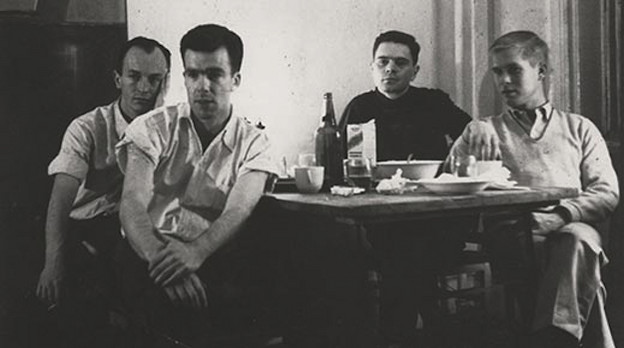
Frank O'Hara, John Button, James Schuyler, and Joe LeSueur, 1960. Photo by John Button.

7/7/88

An emergency, reading that James Schuyler “was born in 1933” — so says the jacket note on The Crystal Lithium. That would make him a mere six years older than I, seven years younger than Frank O'Hara, one year older than Ted Berrigan, and so on — a fact behind his accomplishment which my vanity calls unacceptable. But the jacket for Hymn to Life says, “born in 1923.” So there. (Though where vanity rears its horny head there can be no real relief).

***

The city poet who knows, like no other, the names of all flowers. Of whom else can it be said, he is our best (or only) descriptive poet? Was this ever said, as it might have been, of John Clare? “You can’t get at a sunset naming colors.” Every poem, a view. The sense in each of a scrim of exact detail so carefully woven as to be seamless, impregnable to the monsters raging, ready to pounce or tear through from the other side.            The central character, if any, of most of his poems is the day, the poem geared to get it down, nail it in its lineaments as it appears and goes: “a nothing day,” “day the color of a head cold,” “Dark day,” “a day subtle and suppressed,” “May 24th or so,” “a day like any other,” and so on. His writing has what filmmakers call “room tone,” c.f., Charles North’s remark about Schuyler’s perfect pitch.

***

One hot day in 1961, when I was working in the office at ARTnews, Tom Hess said, “Go down to Jimmy Schuyler’s and pick up his reviews.” I hardly knew Jimmy then, but I had heard from John Myers that he had been having psychiatric troubles. The reviews for that month were long overdue; Jimmy apparently had told Tom that he had them but in his present mental disarray couldn’t manage the trip uptown from his place on lower Broadway to deliver them. Once there, I rang the bell a few times and got no response. Baffled as to what to do next, I went to a corner phone booth and called Frank who suggested I try Jimmy’s number. That worked, and Jimmy buzzed me in. The apartment was a mess, Jimmy in pajamas sort of silently, aimlessly padding around the front room. No, he said firmly, giving me a somewhat stony look, there were no reviews. I left, feeling useless and rude, an intruder in someone else’s private soul dust.


Schuyler told an interviewer that, to engage his interest, he sometimes wrote the first drafts of his art reviews in verse lines, then later rearranged them, closed up and slightly altered, in paragraphs. According to Frank O’Hara, the 1950s ARTnews poets Barbara Guest, John Ashbery and O’Hara himself, used to show their monthly short reviews and longer articles to Jimmy for style checks. Frank said,  “Jimmy was the real writer; he knew where the commas were supposed to go.”

***

Cy Twombly [Stable; through January], fleeing for his creative life from the white hell of Black Mountain, shows Siberian slabs (those diamonds they’ve found there, what makes them so sure they’re not just frozen tears?). Fabulously underpriced. J.S. [1957]

***

Schuylerism

The prose is golden, in the same sense as Jane Freilicher’s great painting Goldenrod Variations: the prodigious scope alive to, never stumped by, whatever vibrant detail is there, and the sense, too, that all this happens in time and constitutes, in its way, history, human and otherwise. Such accurately directed empathy taken to its eternal edge. About the hornet in the room in “Buried at Springs”: “One of us will have to go.” Or how incomparably, as if Francis Ponge were taking a refresher course in how real both things and the words for them can get, “Trembling, milk is coming into its own.” The under-appreciated (although now in reprint via NYRB) novel What’s for Dinner? does just what Henry Green ordered, “Ring tears from the stone.” The poetry follows suit, even increasingly edgier:

So many lousy poets
So few good ones
What’s the problem?
No innate love of
Words, no sense of
How the thing said
Is in the words, how
The words are themselves
The thing said: love,
Mistake, promise, auto
Crack-up, color, petal,
The color in the petal
Is merely light
And that’s refraction:
A word, that’s the poem.
A blackish-red nasturtium …


Frank O'Hara and everybody


Back row, from left: Lisa De Kooning, Frank Perry, Eleanor Perry, John Bernard Myers, Anne and Fairfield Porter, Angelo Torricini, Arthur Gold, Jane Wilson, Kenward Elmslie, Paul Brach, Jerry Porter, Nancy Word, Katharine Porter, unidentified woman. Second row: Joe Hazan, Clarice Rivers, Kenneth Koch, Larry Rivers, Miriam Shapiro, Robert Fizdale, Jane Freilicher, Joan Ward, John Kacere, Sylvia Maizell. Sitting and kneeling in front: Stephen Rivers, Bill Berkson, Frank O'Hara, Willem de Kooning, Alvin Novak. Photo by John Jonas Gruen. 

Back row, from left: Lisa De Kooning, Frank Perry, Eleanor Perry, John Bernard Myers, Anne and Fairfield Porter, Angelo Torricini, Arthur Gold, Jane Wilson, Kenward Elmslie, Paul Brach, Jerry Porter, Nancy Word, Katharine Porter, unidentified woman. Second row: Joe Hazan, Clarice Rivers, Kenneth Koch, Larry Rivers, Miriam Shapiro, Robert Fizdale, Jane Freilicher, Joan Ward, John Kacere, Sylvia Maizell. Sitting and kneeling in front: Stephen Rivers, Bill Berkson, Frank O'Hara, Willem de Kooning, Alvin Novak. Photo by John Jonas Gruen.


James Schuyler for John Ashbery


 Destitute Peru

For John Ashbery

We pullmaned to Peoria. Was
Gladys glad, Skippy missed
Sookie so. So Peru-ward, home.
“I’ll sew buttons on dresses yet.”

Nike’s peach-knife nicked little
finger Chinese straw finger-cuffed
to Minna’s Siamesed. Hartford,
how are your wheres, our whens?

Or extirpated traumas’ gifted
guilt smothered aboard a club
car. Lake Ontario spilled
Jo Jo’s knapsack: “Pasternak.”

An alligator ate an alligator-
trapping monkey. We ate because
“it’s dark, it’s air-conditioned”
like lurching to the movies,

shot marbles in lobbies. What
interests? Takes? Escapes? Eat,
moth-light, part and apart, slowly
we slow waiters serve hot plates.

James Schuyler


John Ashbery and James. Schuyler, painting by Fairfield Porter, 1967


The Bluet 

And is it stamina
that unseasonably freaks
forth a bluet, a
Quaker lady, by
the lake? So small,
a drop of sky that
splashed and held,
four-petaled, creamy
in its throat. The woods
around were brown,
the air crisp as a
Carr's table water
biscuit and smelt of
cider. There were frost
apples on the trees in
the field below the house.
The pond was still, then
broke into a ripple.
The hills, the leaves that
have not yet fallen
are deep and oriental
rug colors. Brown leaves
in the woods set off
gray trunks of trees.
But that bluet was
the focus of it all: last
spring, next spring, what
does it matter? Unexpected
as a tear when someone
reads a poem you wrote
for him: "It's this line
here." That bluet breaks
me up, tiny spring flower
late, late in dour October.


James Schuyler


Tuesday, October 30, 1990

The sky at 6 clear and gray as blotting paper, a sky for which the loud unmodulated grind of a garbage truck is the fitting music on the right instrument.
Tomorrow morning Tim Dlugos is going to be interviewed, and to read part of his long poem just published in The Paris Review, on one of the morning talk shows—”Good Morning America,” I believe it’s called. If only this were not in a segment called “Living with AIDS”! His latest affliction is one suffered only by people with AIDS and birds, which causes his temperature to go rocketing up and up. A line of Stevens kept coming into my mind: “Dying lady, rejoice! rejoice!” How can he? Why should he? Because he’s going to Abraham’s bosom? Bur he’d prefer to stay in his Christopher’s arms.

from The Diary of James Schuyler, ed. Nathan Kernan, Black Sparrow Press, 1997

James Schuyler


February

A chimney, breathing a little smoke.
The sun, I can’t see
making a bit of pink
I can’t quite see in the blue.
The pink of five tulips
at five p.m. on the day before March first.
The green of the tulip stems and leaves
like something I can’t remember,
finding a jack-in-the-pulpit
a long time ago and far away.
Why it was December then
and the sun was on the sea
by the temples we’d gone to see.
One green wave moved in the violet sea
like the UN Building on big evenings,
green and wet
while the sky turns violet.
A few almond trees
had a few flowers, like a few snowflakes
out of the blue looking pink in the light.
A gray hush
in which the boxy trucks roll up Second Avenue
into the sky. They’re just
going over the hill.
The green leaves of the tulips on my desk
like grass light on flesh,
and a green-copper steeple
and streaks of cloud beginning to glow.
I can’t get over
how it all works in together
like a woman who just came to her window
and stands there filling it
jogging her baby in her arms.
She’s so far off. Is it the light
that makes the baby pink?
I can see the little fists
and the rocking-horse motion of her breasts.
It’s getting grayer and gold and chilly.
Two dog-size lions face each other
at the corners of a roof.
It’s the yellow dust inside the tulips.
It’s the shape of a tulip.
It’s the water in the drinking glass the tulips are in.
It’s a day like any other.


Tuesday, October 30, 1990

The sky at 6 clear and gray as blotting paper, a sky for which the loud unmodulated grind of a garbage truck is the fitting music on the right instrument.
Tomorrow morning Tim Dlugos is going to be interviewed, and to read part of his long poem just published in The Paris Review, on one of the morning talk shows—”Good Morning America,” I believe it’s called. If only this were not in a segment called “Living with AIDS”! His latest affliction is one suffered only by people with AIDS and birds, which causes his temperature to go rocketing up and up. A line of Stevens kept coming into my mind: “Dying lady, rejoice! rejoice!” How can he? Why should he? Because he’s going to Abraham’s bosom? Bur he’d prefer to stay in his Christopher’s arms.

from The Diary of James Schuyler, ed. Nathan Kernan, Black Sparrow Press, 1997

 Light from Canada


A wonderful freshness, air
that billows like bedsheets
on a clothesline and the clouds
hang in a traffic jam: summer
heads home. Evangeline,
our light is scoured and Nova
Scotian and of a clarity that
opens up the huddled masses
of the stolid spruce so you
see them in their bristling
individuality. The other
day, walking among them, I
cast my gaze upon the ground
in hope of orchids and,
pendant, dead, a sharp shadow
in the shade, a branch gouged
and left me "scarred forever
‘neath the eye." Not quite. Not
the cut, but the surprise, and
how, when her dress caught fire,
Longfellow’s wife spun
into his arms and in the dying
of its flaring, died. The
irreparable, which changes
nothing that went before
though it ends it. Above the wash
and bark of rumpled water, a gull
falls down the wind to dine
on fish that swim up to do same.

Barbara Guest

  Santa Fe Trail I go separately The sweet knees of oxen have pressed a path for me ghosts with ingots have burned their bare hands it is th...