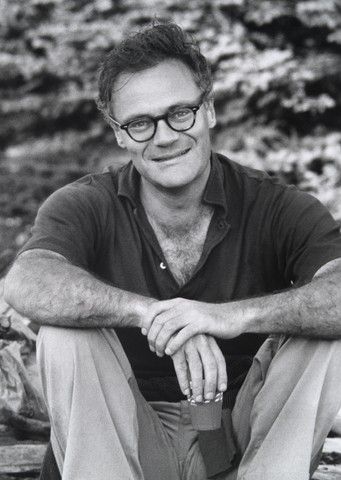
As a child, John Wieners (Jackie, the family called him) ‘was a little eccentric, maybe, and extremely bright,’ says his cousin Arlene Phinney. ‘He had a double promotion at St. Gregory’s. But what I remember best is his kindness.’ The excesses that Wieners’s publisher Raymond Foye would later characterize as his ‘extravagant personality’ were only hinted at during his years at Boston College. Wieners majored in English, worked in the library on a fellowship, and was literary editor of the Stylus, for which he wrote a poem about the death of the actress Gertrude Lawrence — his first publication. (Wieners has had a lifelong fascination with singers and actors. ‘He dreams of being a monied movie star,’ says Jim Dunn, ‘or a beautiful woman.’)
While an undergraduate Wieners lived at home in Milton and commuted to campus every day. ‘I had a gang of girls drive me,’ he remembers, pleased. Twenty or so years later he went back to the college to give a poetry reading. Charles Shively recalls it as a great moment. ‘He wore a gold lamé bullfighter’s jacket, and Father [Francis] Sweeney did the introduction. John’s relatives were there, and John was splendid. It was sort of like home-boy-makes-good.’
After graduating from BC in 1954 Wieners heard the poet Charles Olson give a reading at Boston’s Charles Street Meeting House on the night of Hurricane Hazel. Wieners was literally swept out of town by Olson’s work, and subsequently spent a year at the experimental Black Mountain College in North Carolina, where Olson taught poetry. It was at Black Mountain that Wieners met the poet Robert Creeley, with whom he formed a lifelong friendship, and who was struck by his ‘great quiet and particular manners.’ (To this day Wieners’s friends remark on his chivalrous demeanor; Jim Dunn says, simply, ‘he has the manners of a saint.’)
Wieners’s ‘great quiet’ contributed, ironically, to the development of his hip image. Frank O’Hara found Wieners at 23 to be ‘always quietly mysterious.’ O’Hara biographer Brad Gooch commented that Wieners had a ‘shy and darkly retiring manner, which registered on many as the appropriately cool and aloof stance of a hipster.’ O’Hara was also infatuated with the whiff of danger that clung to the young poet, particularly his drug use and instability: what Wieners called his ‘avowal to mental illness as a youth.’
An incident from this time — when Wieners spent a week in New York City, sleeping on O’Hara’s couch — was recounted by O’Hara’s partner Joseph LeSueur. ‘Saturday afternoon John went to do some sort of research at the 42nd Street public library while we went to see The Curse of Frankenstein at Loew’s Sheridan. That evening John, high on Benzedrine, came home and told us about the horrifying, hallucinatory experience he’d had at the library. Later I said to Frank, ‘Isn’t it funny? We go to a horror movie and don’t feel a thing, and John just goes to the library and is scared out of his wits.’
On the eve of his own fame, O’Hara wrote Wieners a poem called ‘To a Young Poet’
A YOUNG POET
full of passion and giggles
brashly erects his first poems
and they are ecstatic
followed by a clap of praise
from a very few hands
belonging to other poets.
He is sent! and they are moved to believe, once more,
freshly
in the divine trap.
His career launched by O’Hara, in 1957 Wieners made for San Francisco in the footsteps of another Massachusetts boy, Jack Kerouac, whose novel On the Road had appeared earlier that year. Asked recently how he had liked life on the West Coast, Wieners replied dryly, ‘Well, the weather was much better.’ So was the social and artistic landscape. Wieners had moved west with a man named Dana, his lover of six years. When they broke up Wieners retired to his room at a boardinghouse in San Francisco’s red-light district and in less than a week composed a volume called The Hotel Wentley Poems (Auerhan Press, 1958; Dave Haselwood, 1965), which instantly became a classic of modern melancholy. It read, wrote Raymond Foye, ‘like a résumé of Beat poetry and of late romanticism as a whole: urban despair, poverty, madness, homosexual love, narcotics and drug addiction, the fraternity of thieves and loveless transients.’
The word ‘Beat’ comes from an offhand remark made by Kerouac, who called himself and his postwar peers ‘a beat generation,’ meaning down-and-out, or ‘finished.’ Beat poet John Clellon Holmes defined it as ‘the feeling of having been used, of being raw.... [I]t involves a nakedness of mind, and, ultimately, of soul... of being pushed up against the wall of oneself.’ What began as a literary movement, practiced most famously by Kerouac, Allen Ginsberg, Gregory Corso, and William S. Burroughs, quickly became a sociological phenomenon: a rebellion against middle-class respectability, a belief that only in extremity can one feel anything in a world increasingly numbed by comfort and conformity.
The best-known Beat writing reveled in a kind of corresponding literary extremity. Ginsberg’s primal wail against the atomic age — his long masterpiece, ‘Howl’ — used profanity and slap-you-in-the-face staccato rhythm to get the reader’s attention, as did Kerouac’s On the Road, which read like a high-speed joy ride. John Wieners, on the other hand, lived the Beat aesthetic more than he practiced it stylistically in his writing, which through economy and elegance achieved a lyricism unknown in the poetry of his peers.
It is a simple song:
to long for home and him
lounging there under the moon.
Who is my heart, what is he
that he should mean this much to me?
— From ‘The Woman’
Asked if he considers himself a Beat poet, Wieners leans forward in his squeaky chair, takes a drag on his cigarette, and courteously replies, ‘Yes, I do.’ Satisfied, he settles back again and waits in silence for the next question. Prodded into elaborating, he continues, ‘Well, the movement got some publicity, and I didn’t.’ He adds that working at City Lights, Lawrence Ferlinghetti’s famous San Francisco bookstore, ‘gave me a Beat image.’
Others find Wieners’s association with the Beats purely a generational tag. Says Robert Creeley, ‘If “Beat” is to cover poets at the time who had, as John, put themselves entirely on the line — “At last. I come to the last defense” — then he was certainly one. But I think better to see him as The New American Poetry locates him, singular and primary — not simply as a “Beat” poet, nor defined only by drug use, nor a regional poet, nor one of a “school.” Because that begs all the particulars of John’s writing, his immense articulation of the situation and feelings in a relationship with another — literally, love. It’s not a question of gay or straight — it’s how we, humanly, are attracted to and moved by one another, how we know another as being here too. There is no greater poet of this condition than John.’
Ultimately, the Beat hero resonated so deeply in popular culture that he became subsumed within it as the rebel without a cause and, inevitably, as Jumpin’ Jack Flash on the stage of perpetual alienation known as rock and roll. The Beats themselves either became cultural icons (Ginsberg), died young (Kerouac), or quit smoking and moved to the suburbs (most of the others). Wieners did none of those things. His lifestyle was always in service to his poetry, so he simply went on living to write, often in poverty, sometimes in mental institutions, always in obscurity. He quietly became, in effect, Rimbaud’s voyant.
In the introduction to Wieners’s Selected Poems: 195–1984, published by Black Sparrow Press, Ginsberg writes, ‘John Wieners’s glory is solitary, as pure poet — a man reduced to loneness in poetry, without worldly distractions — and a man become one with his poetry. A life in contrast to the fluff and ambition of Pulitzer, National Book Awardees, Poetry Medallists.’ Robert Creeley says, simply, ‘His poems had nothing else in mind but their own fact.’ Wieners himself, questioned in his Joy Street apartment about what Ginsberg meant when he called him a ‘pure poet,’ says in his deadpan Boston accent, ‘He meant that I was Irish Catholic.’
Not only did Wieners’s inherent modesty conspire against potential fame, so did his poetry. It was the stylistic objective of the Beats never to be ignored — to be a cacophony of loud, new, aggravating voices. Wieners’s lyricism, by contrast, held elegance and introspection but not modernity, the engine behind the celebrity-making machine of the 20th century. ‘Why the inattention?’ critic Jack Kimball asks rhetorically. ‘Of all postmoderns Wieners comes closest to 17th-century intellectual laws, paying tribute in denial of pure patented mystique, free will, final causes.’ Wieners’s ‘lack of modernity,’ Kimball says, has been ‘one motive for slackened interest.’
Wieners is a poet but never a showman; in fact, his approach to his career has been casually negligent at best. Of the three plays and 29 volumes of prose and poetry he’s seen published, only three remain in print; it is hard to picture him shopping his books around publishing houses to get them reissued. Possibly because of his penchant for mental recycling, he is notorious for throwing work away, imagining the crumpled scrap as but one incarnation of an idea. Boston publisher and poet Bill Corbett claims that Wieners is ‘self-effacing about his work to the point of almost erasing it.’ The poet himself once said, ‘I am living out the logical conclusion of my books, and those are out of print.’
Relative obscurity hasn’t meant that Wieners doesn’t have a following, especially among other poets. ‘He’s the poetic equivalent of the Velvet Underground,’ says Jim Dunn. ‘What’s the famous saying about them? Only a thousand people bought their albums, but they all started rock bands. It’s the same with John. He’s an inspiration.’
At last. I come to the last defense.
My poems contain no
wilde beestes, no
lady of the lake music
of the spheres, or organ chants,
yet by these lines
I betray what little given me.
One needs no defense.
Only the score of a man’s
struggle to stay with
what is his own, what
lies within him to do.
Without which is nothing,
for him or those who hear him
And I come to this,
knowing the waste, leaving
the rest up to love
and its twisted faces,
my hands claw out at
only to draw back from the
blood already running there.
Oh come back, whatever heart
you have left. It is my life
you save. The poem is done.
— ‘From A Poem for Painters’
After returning from San Francisco to the East Coast in 1959, Wieners did graduate work at the State University of New York, at Buffalo, and eventually settled in Boston, where he has remained. He continued to use drugs and alcohol, often excessively. ‘You don’t have the same self-protective faculties after you’ve taken narcotics,’ he said in a 1970s interview with Charles Shively. ‘The senses that the human organism has equipped itself with to take care of itself, to protect itself.... These all dissolve. I’d had two or three years of steady marijuana and peyote daily.... I was living in a visionary state, so that eventually the conscious faculties were being used to a minimum.’
Understandably, Wieners’s friends concentrate on the whimsical side of these years. Shively recalls riding the monorail at Disney World with Wieners and Allen Ginsberg in 1972, because they couldn’t afford to go on the rides. ‘At first they wouldn’t admit John because he was wearing only a Speedo bathing suit with a Zippie button. But I gave him my shirt and went in my undershirt.... Afterwards it rained and there was a big rainbow over the parking lot.’


 f
f