Friday, January 28, 2022

Tom Clark


Sounding Chinese at Inspiration Point


Nice spring day off big white cloud
At Inspiration Point escaping time wars
Poet takes book & wine bottle up into Mist Mountains

Since only available agenda is rhyming with silence
Seeking window of opportunity on a wall
I disguise what I have to say by sounding Chinese

Such as stars are now darker and farther away
They take deeper drinks because space is
Drying out afraid to think own thoughts

Administered citizen achieving condition of robot
In public mind things not so good these days
Nor in wrong run will it matter to Tu Fu


Thursday, January 27, 2022

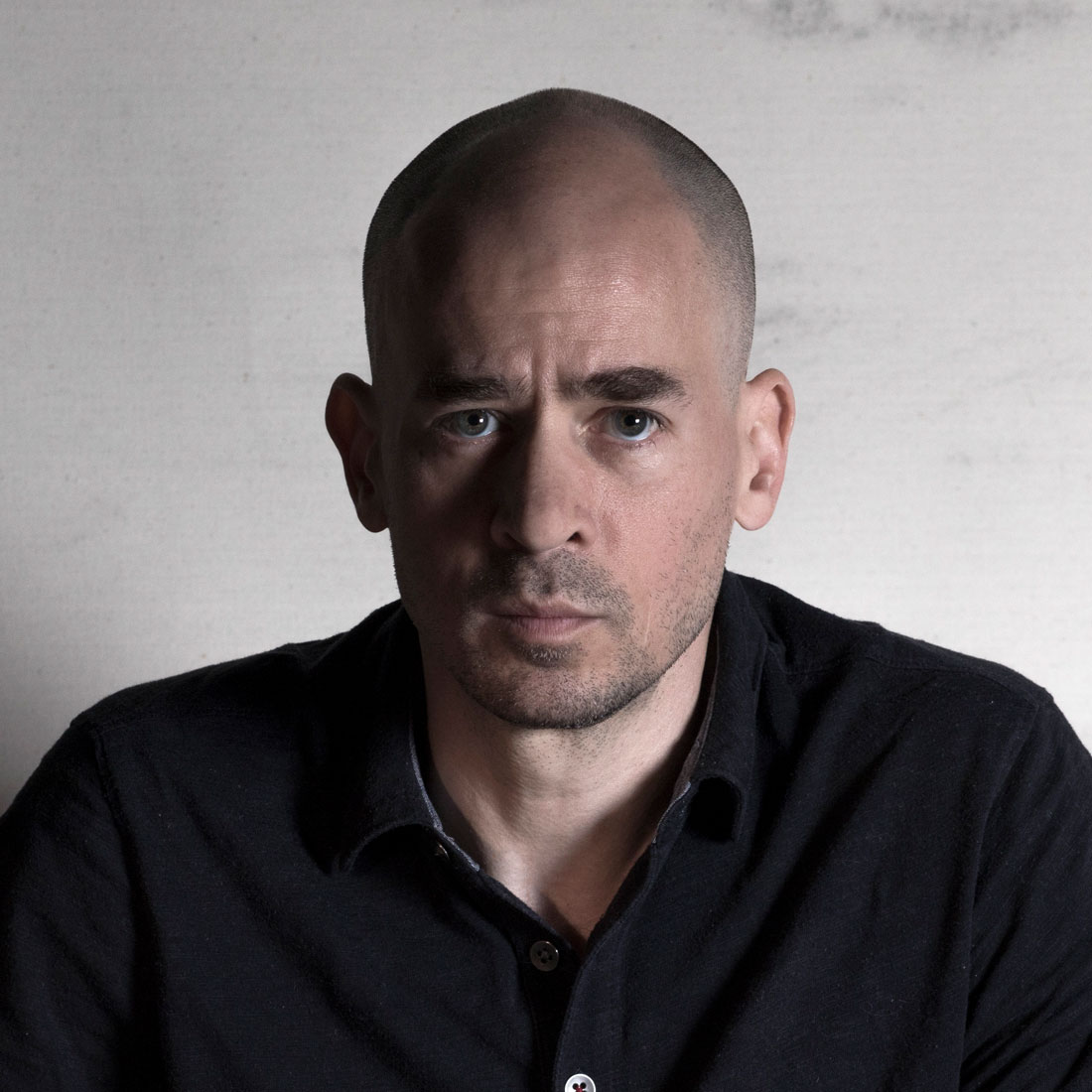
Andrew Zawacki


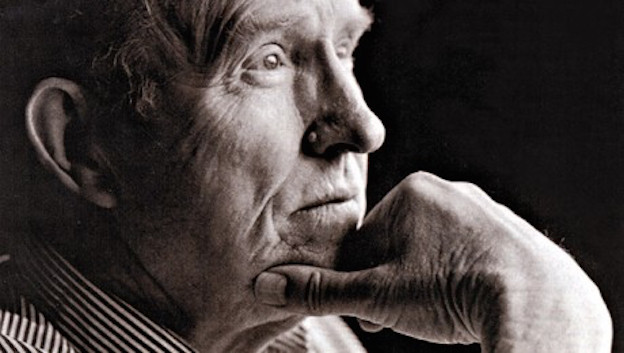
Portrait of Andrew Zawacki 


[Begins in interruption...]

Begins in interruption:
an ambulance bell at the center

of sleep, the room tilts
sideways, furniture slides,

an octet of amber blue
verres à liqueur, one with a cut

at the lip, clatters as a quaalude
light in tatters mattes the

curtains ormolu:
                              I miss you

is what I want to say
like a rocket

stocked from the Reagan
years, its radar gone haywire,

wiring fried but
live inside a bunker of some

private Soviet
Union you & I —


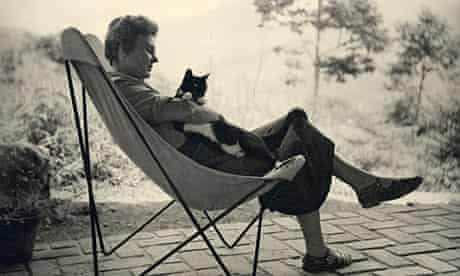
Elizabeth Bishop


Elizabeth Bishop


Filling Station 

Oh, but it is dirty!
—this little filling station,
oil-soaked, oil-permeated
to a disturbing, over-all
black translucency.
Be careful with that match!
 
Father wears a dirty,
oil-soaked monkey suit
that cuts him under the arms,
and several quick and saucy
and greasy sons assist him
(it’s a family filling station),
all quite thoroughly dirty.
 
Do they live in the station?
It has a cement porch
behind the pumps, and on it
a set of crushed and grease-
impregnated wickerwork;
on the wicker sofa
a dirty dog, quite comfy.
 
Some comic books provide
the only note of color—
of certain color. They lie
upon a big dim doily
draping a taboret
(part of the set), beside
a big hirsute begonia.
 
Why the extraneous plant?
Why the taboret?
Why, oh why, the doily?
(Embroidered in daisy stitch
with marguerites, I think,
and heavy with gray crochet.)
 
Somebody embroidered the doily.
Somebody waters the plant,
or oils it, maybe. Somebody
arranges the rows of cans
so that they softly say:
esso—so—so—so
to high-strung automobiles.
Somebody loves us all.

Kenneth. Koch

 You Were Wearing

 
You were wearing your Edgar Allan Poe printed cotton blouse.
In each divided up square of the blouse was a picture of Edgar Allan Poe.
Your hair was blonde and you were cute. You asked me, "Do most boys think that most girls are bad?"
I smelled the mould of your seaside resort hotel bedroom on your hair held in place by a John Greenleaf Whittier clip.
"No," I said, "it's girls who think that boys are bad." Then we read Snowbound together.
And ran around in an attic, so that a little of the blue enamel was scraped off my George Washington, Father of His Country, shoes.
 
Mother was walking in the living room, her Strauss Waltzes comb in her hair.
We waited for a time and then joined her, only to be served tea in cups painted with pictures of Herman Melville.
As well as with illustrations from his book Moby Dick and from his novella, Benito Cereno.
Father came in wearing his Dick Tracy necktie: "How about a drink, everyone?"
I said, "Let's go outside a while." Then we went onto the porch and sat on the Abraham Lincoln swing.
You sat on the eyes, mouth, and beard part, and I sat on the knees.
In the yard across the street we saw a snowman holding a garbage can lid smashed into a likeness of the mad English king, George the Third.


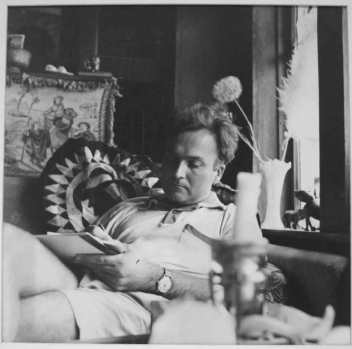
Robert Duncan


Robert Duncan 1959, photo © Patricia Jordan


Poetry, a Natural Thing

 
Neither our vices nor our virtues   
further the poem. “They came up   
      and died 
just like they do every year 
      on the rocks.” 
 
      The poem 
feeds upon thought, feeling, impulse, 
      to breed    itself, 
a spiritual urgency at the dark ladders leaping. 
 
This beauty is an inner persistence 
      toward the source 
striving against (within) down-rushet of the river,   
      a call we heard and answer 
in the lateness of the world 
      primordial bellowings 
from which the youngest world might spring, 
 
salmon not in the well where the   
      hazelnut falls 
but at the falls battling, inarticulate,   
      blindly making it. 
 
This is one picture apt for the mind. 
 
A second: a moose painted by Stubbs, 
where last year’s extravagant antlers   
      lie on the ground. 
The forlorn moosey-faced poem wears   
      new antler-buds, 
      the same, 
 
“a little heavy, a little contrived”, 
 
his only beauty to be   
      all moose.


Mark Strand


13 Madrid, 2013

Madrid, 2013


Fiction

I think of innocent lives
Of people in novels who know they’ll die
But not that the novel will end. How different they are
From us. Here, the moon stares dumbly down,
Through scattered clouds, onto the sleeping town,
And the wind rounds up fallen leaves,
And somebody—namely me—deep in his chair,
Riffles the pages left, knowing there’s not 
Much time for the man and woman in the rented room,
For the red light over the door, for the iris
Tossing its shadow against the wall; not much time
For the soldiers under the trees that line
The river, for the wounded being hauled away
To the cities of the interior where they will stay;
The war that raged for years will come to a close,
And so will everything else, except for a presence
Hard to define, a trace, like the scent of grass
After a night of rain or the remains of a voice
That lets us know without spelling it out
Not to despair; if the end is come, it too will pass.


A. R. Ammons


A. R. Ammons.


Loss

When the sun 
falls behind the sumac 
thicket the 
wild 
yellow daisies 
in diffuse evening shade 
lose their 
rigorous attention 
and 
half-wild with loss 
turn 
any way the wind does 
and lift their 
petals up 
to float 
off their stems 

and go  

Carl Phillips


Unbridled

  
To look at them, you might not think the two men, having spoken briefly 
                and now moving away from each other, as different goals 
                require, have much history, if any, 
between them. That, for a time that seems longer ago now than in fact 
                it’s been, they used to enter each other’s bodies so often, so routinely, 
                yet without routine ever seeming the right way of putting it, 
that even they lost count—back then, 
                who counted? It’s not as if they’ve forgotten, or at least 
                the one hasn’t, looking long enough back at the other 
to admire how outwardly unchanged he seems: still muscled, even if 
                each muscle most brings to mind (why, though) 
                an oracle done hiding at last, all the mystery made 
quantifiable, that it might more easily that way—like love, like the impulse 
                toward love—be disassembled. The other man doesn’t look back 
                at all, or think to, more immediately distracted 
by the dog he had half forgotten at the end of a leash he’d forgotten 
                entirely, though here it is, in his hand, 
                and the dog at the end of it. What kind of dog? The kind whose 
digging beneath the low-lying branches of a bush thick with flowers 
                shakes the flowers loose, they make of the dog’s 
                furious back a fury of petals that the dog takes no notice of, 
though the man has noticed. 
                How the petals lie patternless where they’ve fallen. 
                How there’s a breeze, bit of storm in it. How as if in response 
the dog lifts its dirt-blackened face from the hole it’s digging, 
                then continues digging. Then the man is crying. No, it looks like crying. 
                Now what good at this point do you really think that’s likely to do 
either of us, he says, to the dog. 
  

Adrienne Rich


What Kind of Times Are These

There's a place between two stands of trees where the grass grows uphill
and the old revolutionary road breaks off into shadows
near a meeting-house abandoned by the persecuted
who disappeared into those shadows.
 
I've walked there picking mushrooms at the edge of dread, but don't be fooled
this isn't a Russian poem, this is not somewhere else but here,
our country moving closer to its own truth and dread,
its own ways of making people disappear.
 
I won't tell you where the place is, the dark mesh of the woods
meeting the unmarked strip of light—
ghost-ridden crossroads, leafmold paradise:
I know already who wants to buy it, sell it, make it disappear.
 
And I won't tell you where it is, so why do I tell you
anything? Because you still listen, because in times like these
to have you listen at all, it's necessary
to talk about trees.

Barbara Guest

  Santa Fe Trail I go separately The sweet knees of oxen have pressed a path for me ghosts with ingots have burned their bare hands it is th...